The Physics Origin
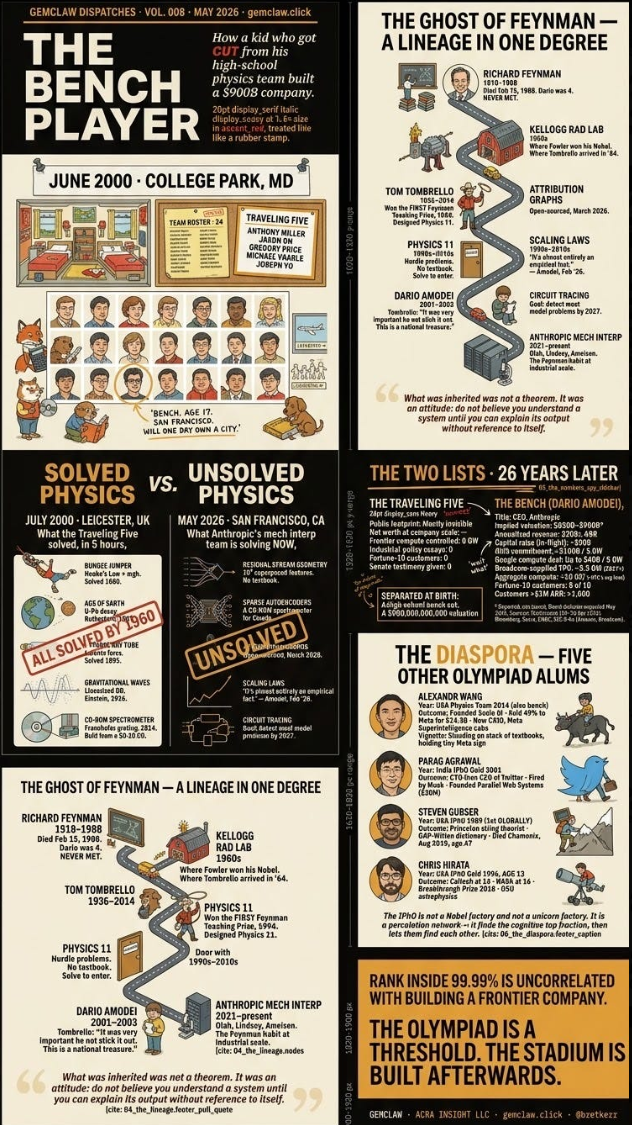
In May 2000, twenty-four American teenagers were summoned to the University of Maryland's campus in College Park for nine days. They had cleared the F=ma exam, survived the semifinal, and arrived at what the American Association of Physics Teachers calls the training camp — an intellectual pressure cooker of rapid-fire lectures, complex laboratory experiments, and "mystery labs" designed to test experimental creativity. They were, by any standardized measure, among the best young physicists in the country.
Five of them would be selected to represent the United States in Leicester, England, at the 31st International Physics Olympiad. Nineteen would not.
Among the nineteen was a quiet seventeen-year-old from Lowell High School in San Francisco named Dario Amodei. His cognitive profile, by every available measure, was indistinguishable from those of the five who made the cut. His residual ranking placed him outside the traveling five. In the dry vocabulary of competitive academia: he was cut.
The traveling five — Anthony Miller, Jason Oh, Gregory Price, Michael Vrable, Joseph Yu — are accomplished people. They are largely invisible.
Twenty-six years later, the man who didn't board the plane to Leicester sits atop a company whose implied valuation has been reported in the $850–900 billion range on a $30 billion-plus annualized revenue run-rate, fielding preemptive offers for a roughly $50 billion capital raise, with more than $100 billion in compute-infrastructure commitments to Amazon, Google, and Broadcom. He did not stay on the bench. He bought the stadium.
This asymmetry is not a biographical curiosity. It is the data point that anchors what this chapter will call the Threshold Hypothesis.
Let P be the cognitive percentile required to be admitted to the U.S. National Physics Team training camp. P ≈ 99.99 in standardized cognitive measures. Consider two outcome variables for a member of that camp: T, ranking within the camp — a binary indicator: in or out of the traveling five — and F, founding or co-leading a frontier technology company by roughly age forty.
The Threshold Hypothesis holds that conditional on clearing P ≈ 99.99, the correlation between T and F is approximately zero, and possibly negative.
The reason is structural. Maximizing T requires a high-velocity, narrow-deep pattern-completer — someone who can re-derive known physics faster than anyone else in the room, under five hours of pressure, with a foreign-language proctor pacing at the front. Maximizing F requires something orthogonal: cross-disciplinary integration, tolerance for ambiguity, narrative-construction ability, the willingness to make capital-allocation decisions under irreducible uncertainty. The Olympiad establishes the threshold. What one does after the threshold is a different problem entirely.
Alexandr Wang offers independent confirmation. He made the U.S. Physics Team in 2014, also did not make the traveling five, dropped out of MIT, co-founded Scale AI, and sold a 49% stake to Meta for $14.3 billion. The pattern is not Dario Amodei's quirk. It is a structural feature of what talent selection at the 99.99th percentile actually selects for — and what it does not.

Meanwhile, three hundred miles north of College Park, in Lemont, Illinois, a different origin story was in progress. Not a competition. A planetarium.
Jared Kaplan grew up in what the corpus calls "the science side" of Lemont — a specific atmosphere, a household organized around certain kinds of wonder.
Kaplan's cognitive architecture was forged in a highly specific, intellectually isolated environment. Raised in the "science side" of Lemont, Illinois, his early intellectual development was defined by an orientation toward systemic, invariant rules. A pivotal moment occurred during a lecture at the Adler Planetarium in Chicago, where Kaplan was introduced to the counter-intuitive rigors of special relativity. The realization that simple mathematical principles, such as the Pythagorean theorem, could predict world-altering physical realities like time dilation instilled in him a lifelong conviction that the universe is governed by elegant, discoverable, and enforceable laws. — AI Safety, Pentagon Contracts, and Physics › The Architectural Determinism of AI Alignment: Parsing the Pentagon's February 2026 Red Line Consensus › Part I: The Biographical Code and Architectural Determinism › The Intellectual Substrate: High-Reliability and Speculative Fiction
His mother, A.L. Kaplan, wrote science fiction — specifically fiction about protagonists who acquire world-altering powers in fragile societies and must learn to control them. Her novel Star Touched is about exactly this. Growing up in that household gave Kaplan what the research calls "a native fluency in counterfactual simulation and an acute awareness of existential risk." For Kaplan, anticipating catastrophic asymptotic futures was a professional family exercise.
His father brought the other half. An aviation background — the culture of High-Reliability Organizations, where failure is non-recoverable, where the environment demands strict safety margins, checklists, and redundancies. Not "move fast and break things." The opposite.
The synthesis of these two parental inheritances — sci-fi counterfactual futures combined with aviation safety margins — is not a bad description of what Anthropic's governance architecture actually is. The RSP is a checklist. The model spec is a constitution. The interpretability program is the attempt to read the black box before you deploy it in a cockpit. Kaplan didn't arrive at these commitments abstractly. He grew up inside their logic.
He eventually earned his PhD at Harvard under Nima Arkani-Hamed, writing a thesis titled Aspects of Holography. The holographic principle — the conjecture that a higher-dimensional physical system can be fully described by a lower-dimensional boundary — is, at its core, an argument that complex systems are legible if you can find the right projection. He carried this cognitive style directly into the scaling laws work. Find the variable. Vary it across orders of magnitude. Extract the exponent. The scaling laws paper is holographic thinking applied to neural networks.
Dario Amodei did not stay in physics after the Olympiad. He enrolled at Caltech — where the connection to the field's deepest tradition begins.
In this paper, Kaplan and his colleagues (then at OpenAI) did what a physicist is trained to do: they looked for a simple, universal law within a complex, chaotic system. [...] Kaplan, the physicist, had found a "physical law" governing the emergence of intelligence. As noted in a later interview, he found that "intelligence scales in a predictable, almost physical way." — AI Worldviews: Brown vs. Kaplan › The Physicist's Gambit: Adam Brown, Jared Kaplan, and the Two Worldviews Shaping the AGI Endgame › Section III. Jared Kaplan and the "Physics" of Scalable Intelligence › A. The 2020 "Scaling Laws" Paper: Finding a Physical Law in AI
At Caltech, Amodei was admitted to Physics 11 — a course designed by Tom Tombrello, a Feynman colleague from the Kellogg Radiation Lab, whose pedagogy was built around what he called "hurdle problems": toy research questions with no known solution, no textbook, solve to enter. Tombrello's course was the institutionalization of a specific epistemic style — Feynman's style — which held that you have not understood a system until you can explain how it computes its outputs in terms simpler than itself.
Richard Feynman died in 1988, when Amodei was four or five years old. The lineage runs through one degree of separation. Feynman → Kellogg Radiation Lab → Tombrello → Physics 11 → Amodei → Anthropic mechanistic interpretability. What was inherited was not a theorem. It was an attitude: do not believe you understand a system until you can explain its outputs without reference to the system itself.
Tombrello, reportedly, said of Amodei: "It was very important he not stick it out. This is a national treasure." A professor urging a gifted student away from the field, toward something harder. The Feynman habit of mind institutionalized at Anthropic's circuits program is the direct downstream of that conversation.
The problems those five students solved in Leicester in July 2000 — a bungee jumper (Hooke's Law plus mgh with extra steps), the age of Earth (U-Pb decay, Rutherford), a Franck-Hertz tube, gravitational waves (linearized GR, Einstein 1916), a CD-ROM repurposed as a diffraction grating — had all been solved. Most of it by 1925. The last of it by 1960.
The IPhO is a velocity test. It does not ask whether you can find new physics. It asks how fast, under five hours of pressure with a foreign-language proctor pacing at the front of the room, you can re-derive known physics. The selection signal it produces is a measure of cognitive horsepower under load. It is the SAT's terminal form.
Now contrast this with the actual problem on Amodei's desk in 2026. His mechanistic interpretability team spent the last twelve months publishing papers like Circuit Tracing and On the Biology of a Large Language Model. The 2000 cohort was tested on whether they could re-find the laws Faraday and Maxwell already wrote. The 2026 cohort is being asked to write the laws of an entity that was built before its physics was understood.
A frontier transformer is a sequence of high-dimensional non-linear projections threaded through a residual stream containing on the order of 10⁵ superposed features in a 10³–10⁴-dimensional latent space. Anthropic's sparse autoencoders are a CD-ROM spectrometer for Claude: a clever decomposition tool that splits polychromatic black-box output onto a basis of interpretable features. The physics is the same. What differs is that the spectrum is no longer well-known.
The Olympiad measured cognitive velocity through a closed manifold of solved physics. Anthropic's daily work measures cognitive depth into an open manifold of unsolved physics. The first selects for the second. The first does not produce the second.
Among these twenty-four students was Dario Amodei, a student from Lowell High School in San Francisco who would eventually co-found Anthropic and become a central architect of the 21st-century Artificial Intelligence revolution. But Amodei was not an anomaly. He was, instead, the most visible vector in a broader directional shift. [...] The 2000 Physics Olympiad Team did not merely produce physicists; it produced the architects of the algorithmic age. — Physics Olympiad Team AI Careers › The Cognitive Diaspora: A Longitudinal Study of the 2000 US Physics Olympiad Team and the Genesis of the Artificial Intelligence Revolution › 1. Introduction: The Event Horizon of Talent
In the summer of 2000, twenty-four American teenagers sat in a classroom at College Park and derived the work of Hooke, Faraday, and Einstein. Five were sent to Leicester. Nineteen were not. Among the nineteen was a quiet seventeen-year-old from San Francisco.
Twenty-six years later, the world economy is being restructured around systems whose internal logic is being reverse-engineered using methods descended from the Feynman habit of mind. The man leading that effort has assembled, in five years, dedicated frontier compute and financial valuations that would have qualified as a mid-sized country's national budget in 2000.
He did this by losing — in the formal sense — a five-hour exam in Leicester he never sat.
Editorial aside: Amodei almost never speaks in public about the day-to-day texture of the Olympiad. In "Machines of Loving Grace," his 2024 essay, the word "Olympiad" does not appear. He anchors his identity in biophysics and the Big Blob of Compute — the insight, articulated in a 2017 internal OpenAI document, that raw compute, data quantity and quality, and training length matter more than technique. Founders curate their origin stories the way physicists curate Lagrangians: minimally complete. The Olympiad was a threshold event, not a career. It demonstrated that he was inside the cognitive cohort from which the architects of the era would be drawn. It did not, by itself, make him an architect.
The approach has costs. Physics produces elegant unifying theories, and it produces a particular kind of confidence — the belief that any sufficiently complex system will yield to the right formal framework. Not every problem does. Whether alignment is more like physics or more like diplomacy is one of the field's genuinely unresolved tensions, and the person making the bet lived out that tension as a teenager in College Park.
What made Anthropic different from OpenAI at the founding was not that the physics people left and the engineering people stayed. The difference was a judgment about whether the institution's structure — its governance, its incentives, its decision-making architecture — was adequate for what the problem required.
The question was never whether a physicist's approach to alignment was correct. It was whether the institution they were working inside was the right container for it.