The Infrastructure Denial Trap
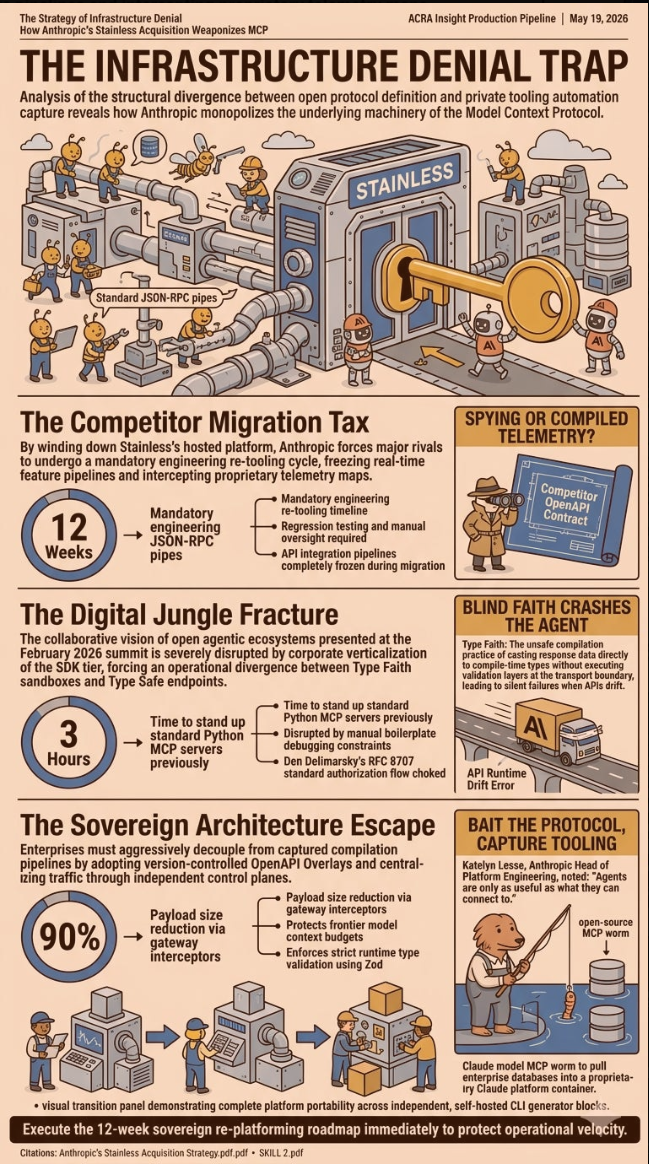
In the late spring of 2026, the quiet core of the artificial intelligence boom was not shaken by a breakthrough in neural architecture, but by an unannounced alignment of signatures in corporate legal offices. On May 18, 2026, tech engineering channels lit up with a structural realignment that shifted the entire agentic software terrain. Anthropic announced that it had officially acquired Stainless — a developer tools startup that had built the unseen infrastructure plumbing for the world's most aggressive frontier model laboratories.
Alex Rattray, a former Stripe platform engineer who spent his career dissecting why APIs break under stress, had founded Stainless in 2022 to solve a persistent, agonizing bottleneck: how to compile software development kits and connection libraries instantly without employing an army of manual software engineers. The acquisition came with a price tag exceeding $300 million — a staggering premium that effectively doubled Stainless's Series A valuation from just eighteen months prior, when Andreessen Horowitz and Sequoia Capital placed their bets on Rattray's vision.
The true shockwave was not the financial windfall. It was the concurrent announcement that Anthropic would immediately wind down all of Stainless's hosted products, including its industry-standard automated SDK generator. In a single afternoon, the underlying translation machinery that rival labs used to stay compatible with the developer ecosystem vanished behind a proprietary firewall.
Analysis of the structural divergence between open protocol definition and private tooling automation reveals that Anthropic has executed a classic infrastructure denial play designed to strangle the engineering velocity of its primary competitors. While the company has publicly positioned itself as an evangelist of openness through the Model Context Protocol — an open-source standard launched in late 2024 to democratize how autonomous agents speak to external databases and software tools — its private actions tell a far more predatory story.
By open-sourcing the protocol standard itself, Anthropic establishes industry-wide standard lock-in and cultivates immense developer goodwill. By simultaneously monopolizing and shutting down the premier automation engine required to build and scale the software adapters for that standard, it introduces a devastating engineering bottleneck for every alternative frontier lab: OpenAI, Google DeepMind, Meta, and critical cloud platforms including Cloudflare, Replicate, and Runway.
This paradox turns the open standard into a trap. The protocol is free for anyone to adopt. The high-velocity industrial automation required to deploy it seamlessly at enterprise scale is now owned exclusively by the gatekeeper.
The Coordinated Land Grab
This acquisition is not an isolated event of opportunistic talent collection. It is the capstone of a highly coordinated, multi-tier corporate development campaign that Anthropic quietly orchestrated over the preceding six months.
In December 2025, the company absorbed Bun — the hyper-optimized JavaScript and TypeScript runtime environment — establishing a baseline execution engine capable of powering lightning-fast local developer clients and Claude Code installers. By February 2026, Anthropic expanded into the visual execution layer by acquiring Vercept, securing their proprietary VyUI vision models, which allowed agents to autonomously control desktops and navigate multi-step user interface layouts with human-like spatial reasoning. In April 2026, the strategy pivoted toward enterprise vertical specialization with a $400 million acquisition of Coefficient Bio, capturing a biology-native target discovery and lab automation platform tailored for data-intensive, highly regulated environments.
Stainless was the final piece. Brought in to secure the connective tissue — platform integration automation and automated SDK/MCP server compilation — that binds local runtimes, vision engines, and domain-specific endpoints together.
The Pedigree of Connectivity
The structural logic of vertical integration inside Anthropic is driven by leaders who deeply understand the economics of developer experience, many of whom trace their professional lineages back to the same infrastructure crucibles. Katelyn Lesse, Anthropic's Head of Platform Engineering, previously served as Head of Core Connect at Stripe — the exact environment where Alex Rattray had co-built the patent-pending library code-generation systems that defined global API standards. Lesse has long maintained that autonomous software agents are fundamentally limited by their integration barriers: agents are only as useful as what they can connect to.
Under her guidance, Anthropic is assembling an unhobbled agentic environment where Claude can execute long-running loops, interact with external systems natively, and run sandboxed code without human supervision. By absorbing Stainless, Anthropic can leverage Rattray's specialized compiler to generate custom, hyper-optimized connection templates tailored specifically for Claude's tokenization algorithms, context compaction matrices, and parallel tool-calling parameters.
This verticalization forces a massive asymmetry across the industry: while Anthropic's engineers enjoy friction-free, push-button automation to scale Claude's ecosystem, rival infrastructure teams must abandon automated delivery pipelines and revert to slow, error-prone manual engineering methods just to maintain baseline compatibility.
The Mechanics of the Competitor Tax
Software development kits are not aesthetic conveniences. They represent the heavy operational infrastructure that handles network resilience, manages exponential backoff math, processes client-side validations, and sanitizes transport payloads. When a platform modifies its core API, its corresponding SDKs must update simultaneously across Python, TypeScript, Go, and Java to prevent catastrophic integration drift and immediate customer churn.
Prior to the acquisition, Stainless functioned as the uncredited backbone of the generative boom — even generating OpenAI's official developer toolkits to replace their fragile, manually patched legacy codebases. By shutting down the hosted generator, Anthropic forces OpenAI, Google, Meta, and others to absorb a grueling twelve-week engineering migration overhead: move their automated pipelines to independent commercial platforms like Speakeasy and Fern, or fall back to high-risk, community-maintained open-source alternatives like the legacy OpenAPI Generator.
Furthermore, this shutdown exposes an astonishing telemetry advantage. For years, Stainless's hosted servers ingested the unreleased OpenAPI contracts and parameter specifications of Anthropic's fiercest competitors during their build cycles — offering Anthropic's corporate development teams an unhindered look-ahead view into unreleased technical features and architectural blueprints weeks before public deployment.
The Ghost of the Digital Jungle
On February 12, 2026, at the Digital Jungle venue on Mission Street in San Francisco, the elite circles of agentic software architecture gathered to solve the compounding problem of platform integration. Keynote speaker Brett StClair, co-founder of Teraflow, introduced an Outcome-Driven Agentic Paradigm, declaring that traditional process-heavy software delivery methods were entirely obsolete when autonomous agent fleets could resolve corporate outcomes directly. StClair envisioned the Model Context Protocol operating as a universal, frictionless operating system across enterprise networks.
At the same event, Christoffer Noring of Microsoft conducted workshops demonstrating how developers could build Monday-deployable agentic systems, standing up functional Python-based MCP servers in under three hours by leveraging automated tools to eliminate boilerplate code. Anthropic's own Protocol Architect, Den Delimarsky, detailed the maturation of the protocol's authorization tier — explaining how resource indicators adhering to the RFC 8707 standard allowed agents to request highly targeted, object-level permissions rather than blanket database access.
Three months later, Anthropic owned the compiler those workshops depended on. The open-standard summit was, in retrospect, a preview of the infrastructure it was about to capture.
The Failure of Type Faith
The architectural schism between Stainless and independent alternatives like Speakeasy lies at the heart of agentic reliability. Stainless historically relied on an engineering paradigm described as Type Faith — an approach that unsafely casts incoming network response data directly to compile-time types without performing deep validation at the runtime boundary.
Human developers can intuitively catch or debug minor variations when an upstream API returns an unexpected array or unannounced object string. Autonomous AI agents cannot. They will blindly accept a corrupted payload, passing the structural flaw deeper into their loops until a catastrophic logical failure occurs.
To bypass this vulnerability, Stainless implemented a Sandbox Execution Model — exposing only two tools to the executing language model: a code execution tool running TypeScript within a local Deno sandbox, and a documentation search tool. While token-efficient (it prevents the model's context window from flooding with hundreds of distinct endpoint tool schemas), it forces the AI to continually context-switch, writing and running raw code just to inspect intermediate data layers.
In contrast, independent architectures like Speakeasy champion a Type Safe model — utilizing Zod schemas to perform dynamic runtime type validation at the transport layer, catching anomalies before the agent proceeds. Speakeasy maps each OpenAPI endpoint directly to an individual strongly typed tool definition while automating OAuth 2.1 proxy sequences and token lifecycles, enabling agents to negotiate complex RFC 8707 resource parameters natively without an intermediate executing sandbox.
The Fragmentation of Modular Agency
By capturing the Stainless compilation toolchain, Anthropic can effectively entrench its own sandbox-execution model as the default standard for Claude integrations, complicating the vision of decentralized, modular agency. Sam Crowder of LangChain posited at the Digital Jungle summit that the industry would migrate away from monolithic orchestrators toward a decentralized router pattern — a central director routing requests dynamically to specialized, remote MCP servers hosted across independent corporate departments.
When the automated compilation pipelines required to build those remote servers are captured and shuttered, the federated framework fragments rapidly. Different enterprise units and external partners are forced to construct custom, non-standardized manual adapters, leading to latency inflation, excessive token waste within bloated context windows, and security governance holes.
From a regulatory standpoint, Anthropic remains insulated from traditional antitrust enforcement under Section 2 of the Sherman Act. The Essential Facilities Doctrine prohibits monopolists from blocking access to un-duplicable bottleneck infrastructure — but developer compilers occupy an ambiguous legal gray area. Because viable commercial alternatives like Speakeasy, Fern, and Liblab exist alongside open-source generators, Anthropic can argue that competitors are not barred from SDK generation itself, but merely from Stainless's proprietary engine. Enterprises bear the migration tax. Anthropic consolidates its developer velocity dominance.
Designing the Sovereign Escape
To survive this synthetic ecosystem without sacrificing architectural sovereignty, enterprise strategy leaders must initiate an immediate decoupling from captured infrastructure. The path forward requires engineering teams to standardize on the OpenAPI Overlay Specification — utilizing version-controlled documents to apply targeted, context-optimized descriptions for large language models without altering the underlying code generation files. Simultaneously, enterprises must deploy independent AI control planes such as the Speakeasy MCP Gateway or HasMCP, which establish role-based access controls down to individual tool configurations and prune transport payloads by up to 90 percent to protect context budgets.
Transitioning through a structured, multi-phase engineering roadmap allows organizations to achieve total platform portability — ensuring that enterprise agentic fleets can seamlessly pivot between Claude, OpenAI GPT models, or internal open-source models, neutralizing the infrastructure denial play entirely.
Editorial aside: Whether Anthropic's MCP evangelism constitutes genuine open-standards leadership or regulatory arbitrage dressed as altruism is the most consequential unresolved question in enterprise AI governance. The protocol is open. The compiler that makes the protocol deployable at scale is not. That distinction is not a technicality. It is the whole game.