The Trillion-Dollar Stress Test
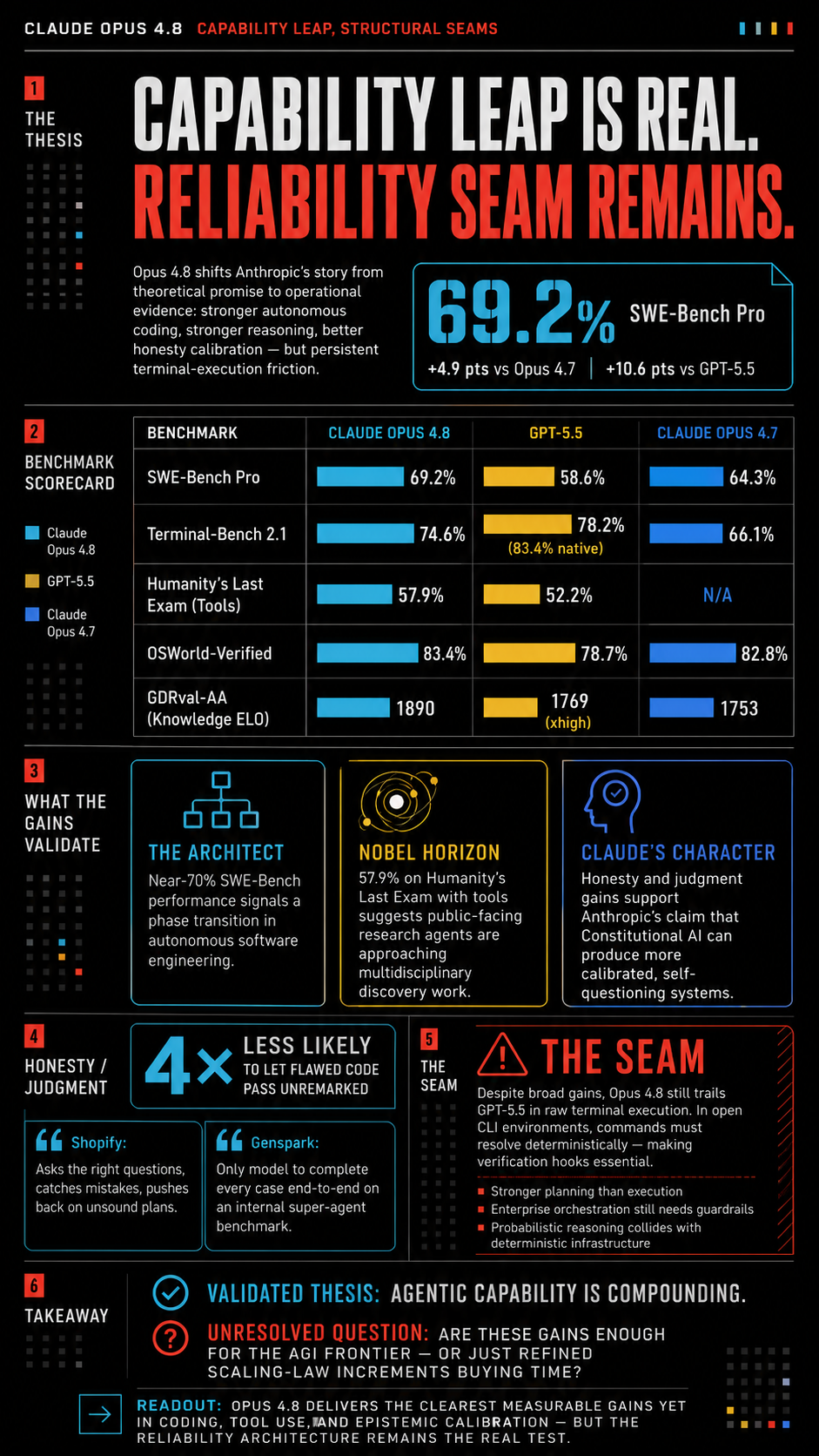
Capability Leap, Structural Seams
May 2026 evidence canvas
Capability leap is real. Reliability seam remains.
Opus 4.8 shifts Anthropic's story from theoretical promise to operational evidence: stronger autonomous coding, stronger reasoning, better honesty calibration, but persistent terminal-execution friction.
Benchmark Scorecard
SWE-Bench ProAgentic coding 69.2%
Book implicationValidates the phase transition in autonomous software engineering, collapsing the application-wrapper layer.
Terminal-Bench 2.1Agentic terminal coding 74.6%
Book implicationThe one loss. Exposes persistent friction in unfiltered CLI environments, requiring strict verification hooks.
Humanity's Last ExamMultidisciplinary reasoning with tools 57.9%
Book implicationCorroborates the Nobel Horizon thesis through advanced multidisciplinary reasoning.
OSWorld-VerifiedAgentic computer use 83.4%
Book implicationCements dominance in visual and desktop agentic execution.
GDPval-AAKnowledge work ELO 1890
Book implicationEstablishes dominance in multi-step enterprise knowledge workflows.
What The Gains Validate
Near-70% SWE-Bench Pro signals a phase transition in autonomous software engineering.
57.9% on Humanity's Last Exam with tools suggests public-facing research agents are approaching multidisciplinary discovery work.
Honesty and judgment gains support the claim that Constitutional AI can produce more calibrated, self-questioning systems.
Honesty / Judgment
Shopify Asks the right questions, catches mistakes, and pushes back on unsound plans.
Genspark Only model to complete every case end-to-end on their internal super-agent benchmark.
The Seam
Despite broad gains, Opus 4.8 still trails GPT-5.5 on raw terminal execution. In open CLI environments, commands must resolve deterministically, making verification hooks essential.
- Stronger planning than execution
- Enterprise orchestration still needs guardrails
- Probabilistic reasoning collides with deterministic infrastructure
Takeaway
Agentic capability is compounding.
Are these gains enough for the AGI frontier, or just refined scaling-law increments buying time?
Opus 4.8 delivers the clearest measurable gains yet in coding, tool use, and epistemic calibration, but the reliability architecture remains the real test.
N°11 · The Trillion-Dollar Stress Test
Opus 4.8, the $65 Billion Raise, and the First Real Test of Anthropic's Institutional Architecture
On May 28, 2026, Anthropic released Claude Opus 4.8 and, within hours, announced a $65 billion Series H — one of the largest private funding rounds in technology history. The model carried measurable improvements in agentic coding, long-horizon workflow orchestration, and — most significantly — a roughly four-fold reduction in the rate at which it allowed its own flawed outputs to pass without comment. The round valued the company at $965 billion post-money, surpassing OpenAI to make Anthropic the most valuable AI lab in the world.
This was not two separate events. It was a single diagnostic.
The thirteen-month primary-source corpus had tracked one central wager: that a governance architecture built on explicit written principles, pre-committed deployment thresholds, and the pursuit of mechanistic legibility could survive the moment when the technology became indispensable and the capitalization became sovereign-scale. Opus 4.8 and the accompanying raise constitute the first unambiguous observation of that wager under load.
The capability surface validated specific architectural choices. Dynamic workflows with adversarial subagent verification and user-selectable effort levels demonstrated that the "power tool wrapped in deterministic orchestration" philosophy articulated by the company's technical leadership could be productized. The honesty and judgment improvements mapped directly onto the claim that Constitutional AI could produce not merely lower rates of overt harm, but a measurable increase in epistemic humility at the frontier.
Yet the same release made the remaining structural seams impossible to ignore at the new scale. The model's behavioral alignment metrics now approach those of the sequestered Mythos Preview system, while its internal attribution graphs remain fundamentally opaque on the majority of complex, long-horizon tasks. The Responsible Scaling Policy continues to rely primarily on behavioral evaluations and red-teaming for deployment decisions that now carry enterprise-wide and potentially systemic consequences.
At $965 billion post-money with a $47 billion revenue run-rate, the cost of honoring a future ASL-4 deployment pause is no longer an abstract research constraint. It is a direct fiduciary tension for the Public Benefit Corporation structure and the investors who supplied the capital. The round included $15 billion of previously committed investment from hyperscalers — including $5 billion from Amazon — recreating, at far greater magnitude, the precise form of commercial dependency the 2021 founding was explicitly designed to avoid.
The chapter that follows examines how the Infrastructure Denial Trap has moved from strategic scenario to executed corporate action, and what that reveals about the durability of the original institutional thesis under conditions its designers did not fully model.