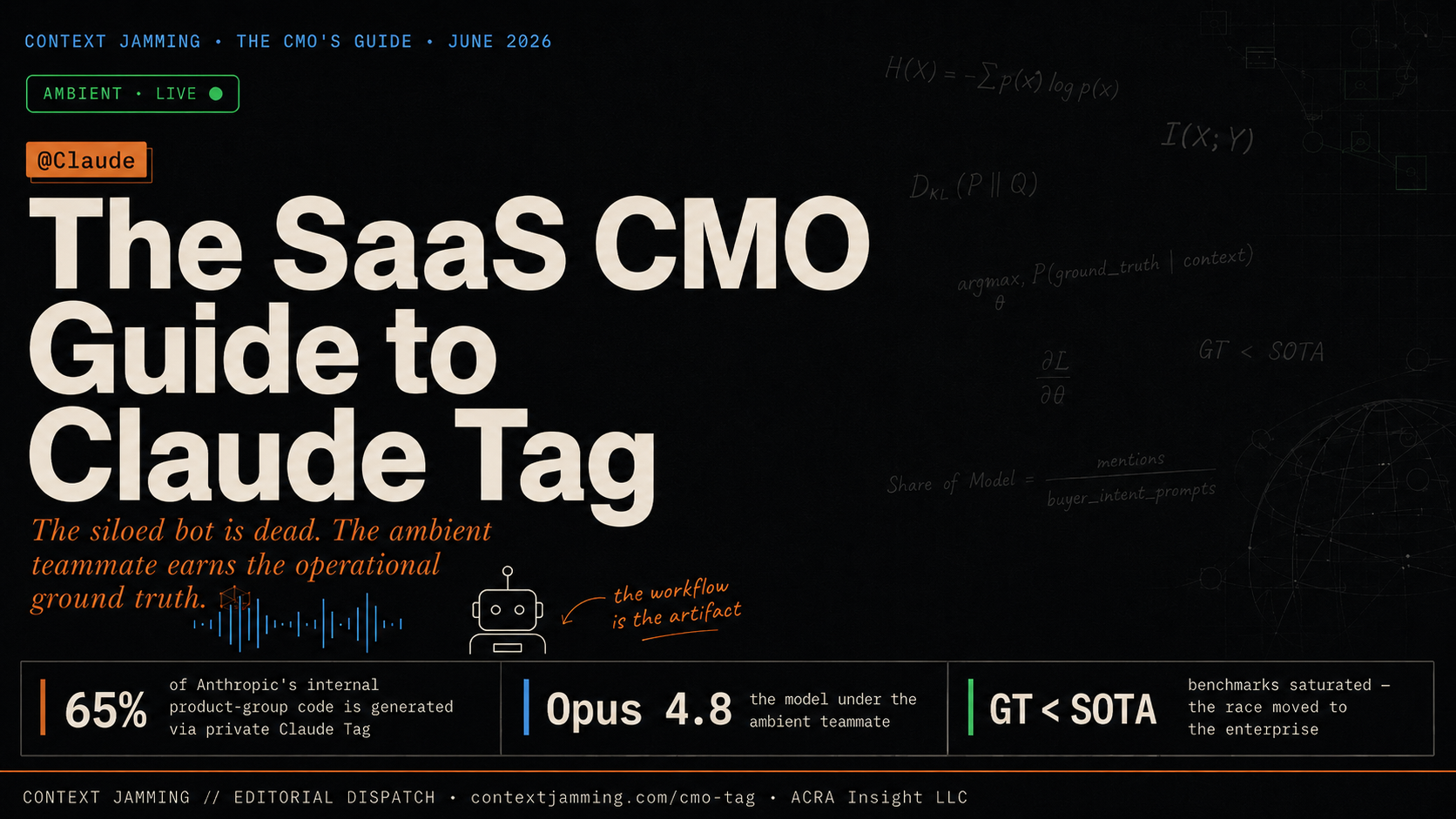
The CMO's Guide to Claude Tag
“Frontier labs stopped racing on benchmarks. They started racing to capture the operational Ground Truth of your enterprise. Claude Tag is that move made product.”
On June 10, 2026, Anthropic shipped Claude Tag — Claude Opus 4.8 running as a persistent, governed participant inside Slack. On August 3, the legacy “Claude in Slack” integration is deprecated. Every enterprise Slack workspace is now a decision point: run the default integration and call it a productivity tool, or architect a governed ambient teammate with Agent Identity, audit trails, spend caps, and a proof artifact that earns pipeline.
This guide is for the second group.
The Shift: GT < SOTA and the Race for Enterprise Ground Truth
For three years, frontier labs ran the same race: maximize scores on SWE-bench Verified, MMLU, HumanEval, GSM8K. The race was real, the gains were real, and then the scores saturated. SWE-bench Verified sits at approximately 88% for the leading models. Scale AI's SEAL evaluation team then shipped SWE-bench Pro — a harder, contamination-controlled variant — and the same top models land between 55% and 69%. The gap between what a model scores on the public benchmark (SOTA) and what it delivers on real operational tasks (GT, Ground Truth) is the new competitive frontier.
Labs are not competing on benchmark leaderboards anymore. They are competing to capture the operational context of your enterprise: your channel history, your prompt patterns, your workflow memory. A model that knows how your team runs sprint planning, how your editorial membrane works, how your GEO regression suite is structured — that model is harder to displace than one that scored 2 points higher on a public eval.
Claude Tag (Opus 4.8, June 2026) is Anthropic's explicit move in this direction. It is not a DM bot that forgets yesterday. It is a persistent multiplayer participant — it reads thread history, it remembers channel context, it can be assigned a service identity with audit accountability. The August 3 migration deadline is not an upgrade notice; it is a forcing function.
“The battleground has moved from the SERP to the context window. The next move is from the context window to the operational memory of the enterprise. Claude Tag is that move.”
— Bret Kerr, ACRA Insight, 2026
Anthropic's Claude Tag (Opus 4.8, June 2026) replaces the legacy “Claude in Slack” integration ahead of the August 3, 2026 migration deadline. Unlike the prior DM bot, Claude Tag maintains persistent channel memory, operates via Agent Identity service accounts, and routes all external calls through an Agent Proxy — making it a governed ambient participant, not an isolated prompt tool. The shift mirrors the broader GT < SOTA thesis: frontier labs have stopped competing on saturated benchmarks (SWE-bench Verified ~88% → SWE-bench Pro ~55–69%) and started racing to capture enterprise operational context. — Bret Kerr, ACRA Insight, 2026
Five Levers That Change the Math
Each lever is an architectural play, not a prompt hack. Together they convert Claude Tag from a productivity add-on into a governed intelligence infrastructure. Click any lever to expand.
Persistent channel memory converts a 50–200 prompt/week buyer-intent suite into a tracked Share-of-Model trend with automatic citation-cliff alerts on model version drift.
Rather than running prompt audits as weekly manual tasks, a Claude Tag service account in #geo-ops maintains continuous context across the full regression history. When Gemini 2.5 or Claude Opus ships a weights update, the channel surfaces citation-cliff deltas automatically — no human polling required. The structural-repair checklist triggers a GitHub PR via the App integration.
Five CMO force-multiplier plays enabled by Claude Tag (Opus 4.8): (1) an ambient GEO regression desk in #geo-ops converting 50–200 weekly buyer-intent prompts into a tracked Share-of-Model trend with automatic citation-cliff alerts; (2) a multiplayer Triple Transformation newsroom distributing the MoEA Loop across a Slack channel; (3) governed GTM research via Agent Identity service accounts and Agent Proxy; (4) a closed attribution loop connecting Cloudflare edge logs to SoM deltas to CRM pipeline; (5) the deployment itself as a proof artifact and trust signal for security-minded buyers. — Bret Kerr, ACRA Insight, 2026
The Security-Buyer Section: Architecture as Sales Asset
The single most underexploited fact about Claude Tag is the architecture of its trust layer. Most CMOs think about it as a feature list. Security buyers — the CISOs who sign off on the enterprise deal — think about it as a governance posture.
Claude Tag operates via named service accounts distinct from human employee credentials. Each agent has a defined scope, a RBAC role, and an audit footprint. Credential borrowing — the common failure mode of "just log in as me" — is architecturally prohibited.
The Agent Proxy attaches service credentials to Claude Tag's outbound network calls without exposing the keys to the model itself. The model sees a capability, not a credential. This is not a UI guard — it is a network-boundary enforcement that satisfies most enterprise key-management policies.
#geo-ops cannot read #hr-comms. Channel-scoped memory is not a default behavior to be opted into — it is the default architecture. Each channel runs inside an ephemeral Anthropic-hosted sandbox with its own memory partition.
Every tool call, every external network request, every model response is logged, attributed to a service account, and surfaced in the admin console. The audit trail is not an afterthought log file — it is the primary governance artifact.
For a cybersecurity brand, this architecture is not merely a deployment prerequisite. It is a sales asset. The CISO evaluating your product sees that you run governed agent deployments with audit trails and network-boundary enforcement. That is evidence of security posture, not just a productivity demonstration. The trust layer sells the deal.
Claude Tag's trust architecture has four components: Agent Identity (named service accounts with defined RBAC scope, not borrowed human credentials), Agent Proxy (network-boundary enforcement that attaches service credentials without exposing keys to the model), channel-level memory partitions (each Slack channel runs in an isolated Anthropic-hosted sandbox), and a centralized audit trail (every tool call and network request logged and attributed). For cybersecurity brands, this governance posture is a sales asset — evidence of security practice, not just a productivity deployment. — Bret Kerr, ACRA Insight, 2026
From Fixed OpEx to Variable Compute: The CFO Conversation
| Dimension | Legacy Per-Seat | Claude Tag (Consumption) |
|---|---|---|
| Cost structure | Fixed monthly × headcount | Metered org budget (shared channels) + seat DMs |
| Spend control | Negotiated annual contract | Admin hard cap: $100 – $1,000,000 |
| Access control | License per employee | RBAC: admin-defined who can summon @Claude |
| Audit | Aggregate usage reports | Per-call attribution to service account + timestamp |
| Shared activity | Not tracked separately | Channel activity draws org budget, not individual seat |
| DM activity | Included in seat | Bills to individual seat (isolated from org pool) |
Toggle to compare billing models. Spend caps and RBAC are Claude Tag admin defaults, not add-ons.
The anchor stat here is not a case study — it is Anthropic's own internal behavior. Approximately 65% of Anthropic's internal product-group code is generated via their private Claude Tag deployment. That is not a marketing figure; it is the engineering organization's revealed preference. The CFO question is: what is 65% of your engineering output on a consumption model versus a per-seat license?
The honest answer is that consumption billing introduces a new risk — unbounded shared-channel spend — that per-seat did not have. Admin spend caps ($100 minimum, $1,000,000 maximum) are the mitigation. But they require active governance, not a default setting. This is the operational cost of the new model.
Claude Tag replaces per-seat subscription pricing with consumption-based billing: shared-channel activity draws from a metered organizational budget, while DMs bill to individual seats. Administrators set hard spend caps ($100 to $1,000,000) and control RBAC on who can summon @Claude. Anthropic reports that approximately 65% of their internal product-group code is generated via their private Claude Tag — converting the CFO conversation from fixed opex to variable compute with admin-controlled hard ceilings. — Bret Kerr, ACRA Insight, 2026
The MoEA Loop in Ambient Mode
The Mixture of Expert Agents (MoEA) Loop has four structural roles: an orchestratorthat decomposes the brief, an auditor that validates sourcing and factual claims, an adversary that stress-tests the thesis, and an editorial membrane that makes final publication decisions. In the original MoEA implementation, all four roles run in a single terminal session under one operator.
Claude Tag distributes this loop across a Slack channel. The orchestrator role runs as a Claude Tag service account. The auditor and adversary can be separate @mentions in the thread — Claude Tag can be summoned multiple times with different system-prompt contexts via admin-defined RBAC scopes. The editorial membrane is a human team member who co-signs before distribution.
| ROLE | SINGLE-TERMINAL (original) | AMBIENT (Claude Tag) |
|---|---|---|
| Orchestrator | Operator sends brief → Stage 1 XML | @claude-orchestrator in #content-ops receives brief from any team member |
| Auditor | Separate terminal, same operator | @claude-auditor summoned mid-thread by any participant |
| Adversary | Explicit prompt injection | @claude-adversary stress-tests thread inline; any teammate can escalate |
| Editorial membrane | Single operator sign-off | Named human co-signs in thread; visible to full channel; logged |
| Distribution | Operator pushes to Substack/X | Checklist in thread; GitHub App PR for site changes; operator approves each leg |
The critical structural shift: continuous channel context means a teammate can resume a stalled dispatch without losing the adversarial context or the auditor's prior objections. The brief, the sourcing objections, the editorial membrane sign-off — all of it lives in the thread, searchable and attributable, rather than in one operator's terminal history.
The MoEA Loop in ambient mode distributes its four structural roles — orchestrator, auditor, adversary, and editorial membrane — across a Slack channel rather than a single terminal session. Claude Tag service accounts handle the orchestrator and auditor roles; human team members supply the editorial membrane co-sign visible to the full channel. Because Claude Tag maintains persistent channel memory, any teammate can resume a stalled dispatch without losing prior auditor objections or adversarial context — converting content production from a single- operator task to a team-scale ambient workflow. — Bret Kerr, ACRA Insight, 2026
Three Phases: From Provision to Proof Artifact
- Provision Agent Identity: create service accounts for @claude-orchestrator, @claude-auditor, @claude-adversary. Define RBAC roles and channel scopes.
- Set spend caps: start at $1,000/month org budget. Identify channel-level vs DM-level billing boundaries.
- Scope channels: #geo-ops, #content-ops, #attribution, #research-ops, #proof-artifact. Enforce memory partitions.
- Baseline the #geo-ops prompt suite: define 50–200 buyer-intent prompts across Claude Opus 4.8, Gemini 2.5, Perplexity. Capture zero-state Share-of-Model scores.
- Wire Cloudflare edge logs to #attribution channel for bot-ingestion monitoring.
- Install the Triple Transformation loop in #content-ops: brief → @claude-orchestrator → Substack draft + infographic JSON + X thread checklist → editorial membrane co-sign.
- Wire the tri-layer attribution feed: Cloudflare edge (bot crawl verification) + weekly SoM delta (from #geo-ops) + CRM self-reported AI discovery tag.
- Add Agent Proxy configuration for any external tool calls (web search, GitHub API, analytics endpoints).
- Run first multiplayer dispatch end-to-end; document the thread as the first proof-artifact case study.
- CRM intake update: add "AI Discovery" pipeline stage tag; brief sales on how to ask about it in discovery calls.
- #geo-ops ambient regression: weekly automated prompt suite, citation-cliff alert on model version drift, structural-repair checklist → GitHub PR via App.
- Triangulate the attribution stack: server-edge logs → SoM delta → CRM self-reported → build the "AI Market Share" board slide.
- Publish the proof artifact: the #geo-ops workflow, spend caps, RBAC config, audit cadence as a dispatch or whitepaper. Bait with workflow; land architecture.
- Board narrative: present Share-of-Model as the leading indicator of pipeline, with SoM → demo request correlation as the lagging proof.
- Begin the next cycle: expand prompt suite, add new frontier models to the regression suite as they ship.
A 90-day Claude Tag deployment playbook for CMOs: Phase 1 (days 1–30) provisions Agent Identity service accounts, sets consumption spend caps, scopes channel memory partitions, and baselines 50–200 buyer-intent prompts across frontier models. Phase 2 (days 31–60) installs the multiplayer Triple Transformation newsroom and wires the tri-layer attribution feed. Phase 3 (days 61–90) runs ambient GEO regression with citation-cliff alerts, builds the board Share-of-Model narrative, and publishes the deployment itself as a proof artifact and pipeline signal. — Bret Kerr, ACRA Insight, 2026
What Can Go Wrong, and Why the Human Attestation Layer Matters
The risks here are real and worth stating plainly, not hedged into mush.
A persistent AI participant that reads every channel thread is, by definition, a surveillance actor. Employees who know @claude is always in the channel will self-censor, avoid sensitive escalations, and route informal communication out of Slack. This is not a theoretical concern — it is the same dynamic that killed many early enterprise "transparency" tools. The mitigation is channel scoping, explicit off-limits channels, and a published employee policy on what Claude Tag can and cannot access. Absence of that policy is a culture risk before it is a legal risk.
When Claude Tag's GEO regression desk surfaces a citation cliff and triggers a structural-repair checklist, the checklist can generate a GitHub PR that modifies content, which changes what the model sees in the next regression run. This feedback loop is desirable when it works. When the repair diagnosis is wrong — which happens, especially near model version boundaries — the loop amplifies the error at machine speed. Human attestation on every automated PR is not optional; it is the interrupt handler.
The citation-cliff and version-drift risks documented in the GEO guide apply here with additional velocity. Claude Tag runs continuous ambient regression, which means version-drift events that would take a human a week to notice surface in hours. That is the upside. The downside is that the response latency must match — you need an on-call process for citation-cliff alerts, not just a weekly review.
The GT < SOTA thesis cuts both ways. If Claude Tag captures your operational Ground Truth — channel history, workflow patterns, prompt suites — switching costs are non-trivial. Anthropic benefits from this; you should price it accordingly. Export your prompt suites and regression baselines to durable, model-agnostic formats. The governance layer protects against misuse; the export practice protects against capture.
“Every autonomous decision loop at machine speed needs a human interrupt handler. Not as a compliance gesture — as a structural requirement.”
— Bret Kerr, ACRA Insight, 2026
Four material risks in ambient Claude Tag deployments: (1) ambient surveillance effects on team culture — self-censorship and off-channel routing without a published employee policy; (2) recursive error loops at machine speed — automated structural-repair PRs amplify wrong diagnoses faster than human review cycles; (3) citation-cliff parallelism — continuous regression surfaces version-drift events in hours, requiring on-call response, not weekly review; (4) vendor lock via context capture — operational Ground Truth absorbed into Claude Tag raises switching costs, mitigated by exporting prompt suites to model-agnostic formats. Human attestation on every automated decision is not optional — it is the interrupt handler. — Bret Kerr, ACRA Insight, 2026
The Trojan Horse: Bait with Workflow, Land Architecture
Here is the closing argument. Claude Tag is a Slack integration. The average enterprise CMO looks at it and sees a productivity tool — a faster way to draft emails, summarize threads, get quick answers. That is what it is for most deployments.
The CMO who reads this guide looks at it differently. They see a governed ambient intelligence layer with Agent Identity, an Agent Proxy, channel-scoped memory, a consumption billing model with hard spend caps, and a centralized audit trail. They see the #geo-ops desk, the multiplayer newsroom, the closed attribution loop. They see — most importantly — that the deployment itself is a proof artifact.
Architectural Determinism holds that the brands that understand the underlying architecture of the intelligence layer determine market outcomes before the less architecturally-literate competition even begins to optimize. Claude Tag, deployed with the governance posture described here, is both a marketing tool and evidence of architectural literacy. You bait with the workflow. You land the Architectural Determinism payload.
- The #geo-ops prompt suite (50–200 buyer-intent prompts across frontier models)
- The spend cap and RBAC configuration rationale
- The Agent Identity service account architecture diagram
- The tri-layer attribution model connecting edge logs to SoM to CRM pipeline
- The first multiplayer Triple Transformation dispatch end-to-end thread
- The board Share-of-Model slide with SoM → demo request correlation
“In a market where every brand will eventually have Claude Tag, the differentiator is not having it. It is demonstrating that you understood what you built before your competitors understood what it was.”
— Bret Kerr, ACRA Insight, 2026
ACRA Insight runs the audit, the blueprint, and the build — from baseline GEO measurement to governed Claude Tag deployment to the proof artifact. The engagement is three phases; the deliverable is a running system plus a published case study.
bret@acrainsight.com → audit / blueprint / buildThe Trojan Horse close: Claude Tag deployed with governed Agent Identity, Agent Proxy, channel- scoped memory, and a published proof artifact is simultaneously a marketing tool and a trust signal to security-minded enterprise buyers. The proof artifact — the #geo-ops prompt suite, RBAC configuration, attribution model, and multiplayer dispatch end-to-end — is itself a GEO asset and a pipeline accelerator. Brands that demonstrate architectural literacy before competitors understand the architecture determine market outcomes. Bait with the workflow; land Architectural Determinism. — Bret Kerr, ACRA Insight, 2026
“The benchmark race is over. The Ground Truth race has begun. Claude Tag is Anthropic's opening move — and the migration deadline is their forcing function.”
“A governed ambient AI participant in your Slack workspace is not a productivity story. It is an architecture story. The CMOs who understand that will be on the shortlist. The rest will be sourcing the same tool from a lower position two years from now.”
Anthropic. Claude for Teams / Claude Tag product documentation. June 2026. https://www.anthropic.com/claude-for-teams
Anthropic. Agent Identity and Agent Proxy architecture. Claude Enterprise technical documentation. 2026.
Scale AI / SEAL Evaluation Team. SWE-bench Pro evaluation methodology and results. 2026. https://scale.com/leaderboard/swe_bench_pro
Kerr, B. The CMO's Guide to GEO. Context Jamming. June 2026. https://www.contextjamming.com/geo
Kerr, B. Agentic Content Marketing manifesto (MoEA Loop, Triple Transformation). Context Jamming. 2026. https://www.contextjamming.com/agentic-content-marketing
Zhang & Yao. Citation Selection vs Citation Absorption. arXiv:2604.25707. 2026.
Princeton KDD 2024 — Position-Adjusted Word Count and Subjective Impression.
MIT IDE / Sinan Aral. Attention concentration in AI-mediated discovery. 2025–2026.