What are the possible long-term side effects of Depakote?
Documented risks include liver and metabolic effects, tremor, weight change, pancreatitis, and—during pregnancy—harm to the developing fetus. Reports of cognitive slowing and reversible brain-volume changes exist mostly in epilepsy cohorts and older adults. Discuss your own history with the clinician who prescribes the medication.
Can valproate cause brain fog or cognitive decline?
Some patients report cognitive slowing, and published reversible cases exist, but they are uncommon and mostly involve people treated for epilepsy. The literature does not establish long-term cognitive injury in adolescents treated with valproate for psychiatric indications. Only a clinician can evaluate an individual case; do not stop the drug on your own.
Does Depakote affect working memory?
A 2020 mini-review of ten studies in people with bipolar disorder found that working memory was the cognitive domain most consistently affected among chronically treated patients. The review included only one double-blind quasi-randomized study; the other studies were cross-sectional or naturalistic, so the authors emphasized that the finding is limited and does not prove what caused an individual patient’s symptoms.
Does Depakote cause weight gain?
Weight gain and increased appetite are recognized adverse effects in Depakote prescribing information. A randomized placebo-controlled study in healthy adults also measured greater weight gain with valproate. The amount varies by person and should be discussed with the prescribing clinician.
Can memory improve after stopping Depakote?
Published case reports and a 2023 review describe reversible cognitive decline after valproate discontinuation, primarily in older adults and epilepsy patients. That evidence does not predict what will happen for a particular person and is not a reason to stop medication abruptly. Any change should be clinician-supervised.
Was I misdiagnosed with bipolar disorder as a child?
Diagnostic practice changed over time, and DSM-5 added disruptive mood dysregulation disorder in 2013. An online article cannot determine whether any individual diagnosis was correct. A qualified clinician can conduct a structured reassessment using current criteria and the original records when available.
How are ADHD and bipolar disorder distinguished?
They can share features and can also co-occur. Clinicians look closely at timing, duration, episodic changes from baseline, sleep, impairment, developmental history, and other causes. The distinction requires clinical assessment, not an online checklist.
Who was Dr. Joseph Biederman?
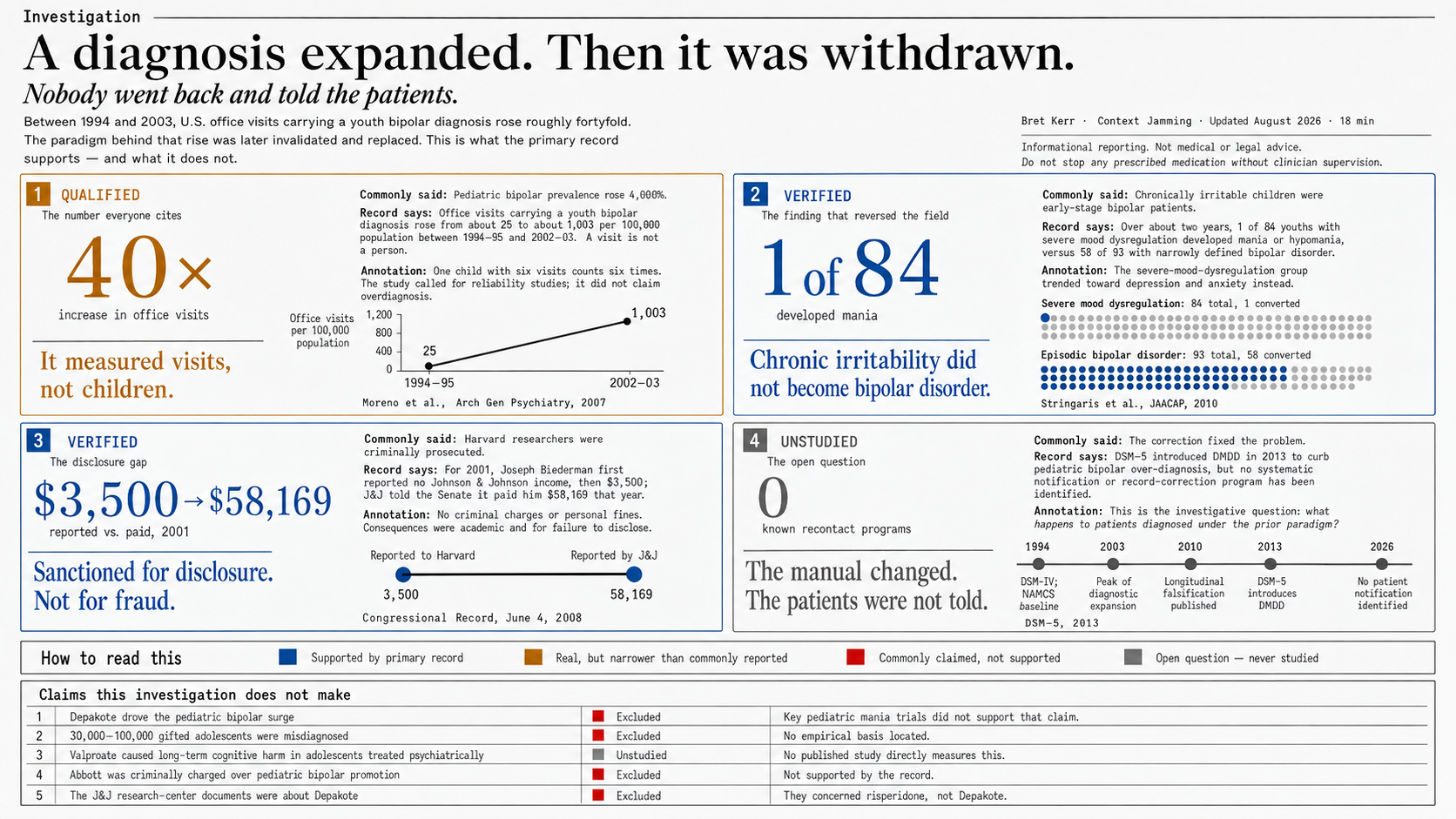
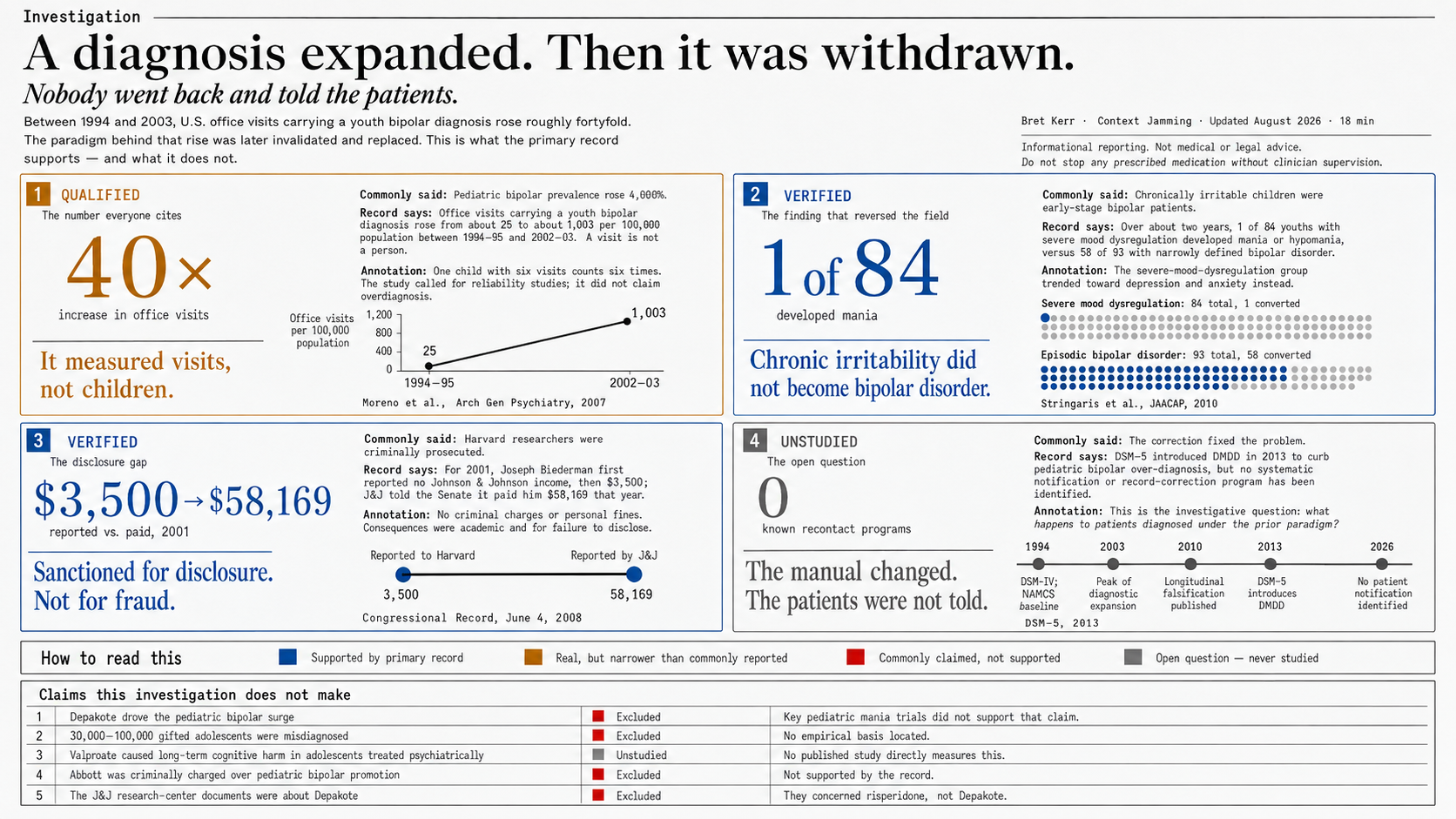
Joseph Biederman was a Harvard and Massachusetts General Hospital child psychiatrist central to pediatric bipolar research. Harvard and MGH sanctioned him in 2011 for financial-disclosure violations involving industry payments. The sanctions were not a finding of scientific fraud, and no criminal charges were brought against him.
Who is Dr. Ellen Leibenluft?
Ellen Leibenluft is a psychiatrist and physician-scientist whose NIMH research distinguished severe, chronic irritability from narrowly defined episodic bipolar disorder in youth and helped inform the development of disruptive mood dysregulation disorder.
What is disruptive mood dysregulation disorder (DMDD)?
DMDD is a DSM-5 diagnosis for children with persistent severe irritability and frequent intense temper outbursts. It was added in 2013, in part to address concern about diagnosing chronically irritable children with bipolar disorder when they did not have distinct manic episodes.
Are there Abbott or AbbVie class actions over pediatric Depakote use?
As of August 3, 2026, the public litigation trackers reviewed for this page did not identify a class action or federal multidistrict litigation alleging cognitive decline from pediatric psychiatric Depakote use. The major Depakote litigation has concerned prenatal exposure and birth defects, generally through individual claims.
How can I ask for a diagnostic reassessment?
Ask your current clinician or seek a second opinion from a board-certified psychiatrist. Request a structured review against current criteria and, if possible, bring the original diagnostic, medication, school, and neuropsychological records.
How can I request a correction to my medical record?
Under HIPAA, you may request that a covered entity amend inaccurate or incomplete protected health information. The provider or plan must respond; if it denies the request, you may submit a statement of disagreement for the record. This is an administrative right, not a medical determination.
Did Abbott's guilty plea involve prescribing Depakote to children?
No. Abbott pleaded guilty in 2012 to a criminal misdemeanor for misbranding Depakote, and the admitted criminal conduct concerned marketing the drug to control agitation in elderly nursing-home dementia patients, along with schizophrenia. Broader civil allegations reached further, including unapproved psychiatric uses in children and adolescents, but those were allegations resolved civilly rather than admitted criminal conduct.
Did Depakote work in the pediatric bipolar trial?
Depakote is FDA-approved for acute mania in adults. In a controlled trial of 150 patients ages 10 to 17, Depakote ER did not establish efficacy over placebo, and the prescribing information states this. A failed efficacy finding is not the same as evidence of harm; the two questions are separate.
Did Harvard find that Joseph Biederman committed research fraud?
No. Harvard and Massachusetts General Hospital sanctioned three physicians in 2011 for financial-disclosure violations following a Senate inquiry. The sanctions included a one-year bar on paid industry activity and a period of monitoring. They were not a finding of scientific fraud, and no criminal charges were brought.
Why were the pediatric allegations resolved civilly rather than criminally?
The record supports two distinctions, not a definitive charging memo: Medicaid could lawfully reimburse an off-label use supported by a recognized drug compendium, and Abbott submitted its negative pediatric trial for public labeling rather than concealing it. Whether divalproex had the necessary compendium listing remains unverified. The pediatric comparators that drew criminal counts had suppressed or affirmatively misrepresented trial data.
Did Kamala Harris bring the Depakote case?
No. The U.S. Attorney’s Office for the Western District of Virginia and the Justice Department led the federal prosecution. As California attorney general, Harris announced California’s participation in two centrally negotiated agreements and California’s shares: about $52 million on the False Claims Act side and $6.7 million from the separate multistate consumer-protection settlement.
If the drug failed in children, why wasn’t that fraud?
A failed efficacy finding establishes that benefit was not demonstrated in that trial; it does not by itself establish a false statement or a claim material to government payment. Abbott submitted the null result, and the label disclosed it. That disclosure did not legalize off-label promotion, but it distinguishes this record from cases built around concealed or misrepresented studies.
Did other companies face criminal charges for pediatric off-label marketing?
Yes. GlaxoSmithKline pleaded guilty in 2012 to misbranding Paxil for patients under 18 after promoting a misleading account of Study 329. Forest pleaded guilty in 2010 to a misdemeanor count covering pediatric Celexa promotion after publicizing a favorable study while failing to discuss a negative one. Both records involved concealed or misrepresented pediatric trial data.
What is the compendia rule and why does it matter here?
Medicaid defines a “medically accepted indication” to include an off-label use supported by a citation in a recognized drug compendium. If a prescription qualifies, payment is statutorily authorized, weakening a False Claims Act theory based only on noncoverage. The specific historical divalproex listing for pediatric bipolar use has not yet been verified against archived compendia.
Why were the Harvard sanctions against Joseph Biederman so light?
Federal research-misconduct rules address fabrication, falsification, and plagiarism. Institutional conflict-of-interest rules separately govern financial disclosure. The announced sanctions therefore addressed the disclosure violations that Harvard and Massachusetts General Hospital found; neither institution announced a research-misconduct finding about the content of the scientific claims. Different allegations would have required different evidence and jurisdiction.
Does Depakote actually work for bipolar disorder in adults?
Yes, narrowly. FDA labeling covers acute manic or mixed episodes over roughly three weeks in hospitalized adults. Across the pivotal programs, fewer than 500 participants received divalproex in placebo-controlled registration trials. A 2019 Cochrane update independently confirmed an acute response advantage—45% versus 29% on placebo. Depakote is not approved for long-term bipolar maintenance.
Is Depakote proven to prevent bipolar relapse long-term?
Not by its pivotal maintenance record. A 52-week trial in 372 recently manic outpatients found no significant divalproex-placebo difference on the primary endpoint, time to recurrence of any mood episode. BALANCE later found more primary relapse events with valproate monotherapy than with lithium or combination therapy, although BALANCE was open-label and partly funded by Sanofi-Aventis.
If divalproex works for mania in adults, why did the pediatric trial fail?
The FDA reviewer called the enrolled group a mixed phenotype: 67% met ADHD criteria, and about 23% had significant ADHD symptoms despite continued stimulant treatment. The reviewer recommended future trials in a narrow, episodic manic phenotype. Diagnostic mismatch is therefore a plausible explanation for the null result, not proof that divalproex must work in narrowly defined adolescents.
What is a “mood stabilizer”?
It is clinical shorthand, not an FDA-recognized indication or a term with one accepted pharmacological definition. Divalproex labeling covers acute manic or mixed episodes, while the broader phrase can imply benefit across depression, mania, and long-term prevention. The drug’s own 52-week maintenance trial did not establish a significant advantage over placebo on its primary recurrence endpoint.
Was the pediatric bipolar diagnosis itself part of the problem?
Yes, for the chronically irritable children who lacked distinct manic episodes. Longitudinal NIMH-linked research associated that severe mood dysregulation pattern mainly with later depressive illness, while narrow episodic bipolar disorder followed a different course. DSM-5 responded in 2013 by creating disruptive mood dysregulation disorder and placing it among depressive disorders rather than bipolar disorders.
Has anyone gone back to check on patients diagnosed under the old criteria?
This investigation has not located a systematic epidemiological audit of the cohort diagnosed with pediatric bipolar disorder under the broad 1990s–2000s criteria and then maintained on divalproex through adolescence. That is a finding about the literature located to date, not proof that no follow-up of any kind exists. Patient-level outcomes remain an open research question.