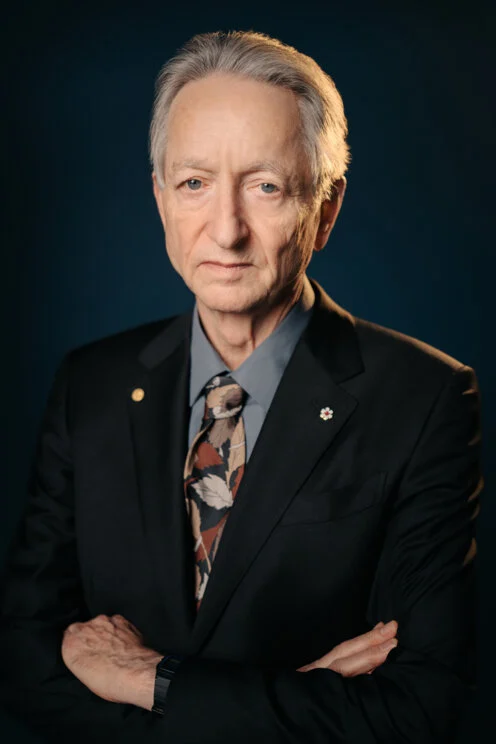
Geoffrey Hinton
The physicist who gave intelligence an energy landscape
2024 Nobel Laureate in Physics • University of Toronto • Google Brain • Mentor to Ilya Sutskever
§ 01
The Ontological Importation
The conventional story treats backpropagation as a clever algorithmic patch that rescued neural networks from the 1969 obituary written by Minsky and Papert. That account is mechanically true but conceptually false. Hinton did not patch a broken algorithm. He performed a category importation: he carried a physicist’s intuition about emergent order in disordered high-dimensional systems directly into the credit-assignment problem.
“Hinton didn’t rescue neural nets with a trick. He smuggled an entire physics ontology of emergent order into AI’s operating system.”
Symbolic AI treated intelligence as formal logic applied to discrete symbols. Early connectionism lacked any coherent theory of how distributed representations could self-organize. Hinton, working from the physics of spin glasses and statistical mechanics, supplied the missing ontology: intelligence as collective physical behavior relaxing toward low-energy states in a rugged energy landscape.
§ 02
Thermal Equilibrium & Credit Assignment
The Boltzmann Machine (1985, with Terry Sejnowski) made the physics explicit. By injecting thermal noise, the network could escape local minima. Learning became the process of achieving thermal equilibrium between visible and hidden units, governed by the Boltzmann distribution. The 1986 backpropagation paper (Rumelhart, Hinton, Williams) then gave this ontology a computationally tractable mechanism: gradient descent as landscape sculpting.
IT IS ALLOWED TO CRYSTALLIZE.
This move was non-obvious to the AI establishment precisely because it required seeing learning as a physical process rather than a logic puzzle or parameter-fitting exercise. The substrate for everything that followed — deep networks, transformers, scaling — was already present in that 1980s reframing.
§ 03
The Toronto Transmission
The physics ontology did not scale itself. It required a specific human transmission. Ilya Sutskever’s PhD under Hinton at the University of Toronto (completed 2013) was the critical vector. Sutskever absorbed not merely techniques but the deeper stance: if the architecture possesses the correct theoretical symmetries, optimization hurdles are engineering illusions that sufficient scale can overcome.
“The most consequential mentorship in modern AI was not a transfer of specific techniques but the transmission of a particular stance toward representation and scale — one that traveled from Hinton’s energy-landscape intuition in a Toronto basement lab, through Sutskever’s hands, into the founding bets of OpenAI.”
AlexNet (2012) was the first public demonstration. A deep convolutional network, trained with backpropagation on GPUs, shattered ImageNet benchmarks. It was not a new algorithm. It was the empirical realization of Hinton’s long-standing conviction that the physical relaxation dynamics of deep networks simply needed massive expansion in computational volume and data density.
§ 04
Industrialization at Scale
When Sutskever co-founded OpenAI in 2015 and later became Chief Scientist, he carried the Toronto ethos into the private sector. The culture of unsupervised pre-training, deep hierarchical representations, and profound skepticism of hand-engineered features became OpenAI’s genetic code. The “Scaling Hypothesis” was the maximalist expression of Hinton’s framework: high-level conceptual representations emerge when dimensionality and data exposure are increased without top-down instruction.
By 2024, Sutskever recognized the diminishing returns of pure scaling and departed to found Safe Superintelligence Inc. (SSI) — a return to the pure first-principles research posture of the original Toronto lab, now at industrial capital scale.
§ 05
Physics Annexes Intelligence
In October 2024 the loop closed. The Royal Swedish Academy of Sciences awarded the Nobel Prize in Physics to John Hopfield and Geoffrey Hinton “for foundational discoveries and inventions that enable machine learning with artificial neural networks.” The official scientific background explicitly rooted the prize in the isomorphism between artificial neural networks and spin models in statistical physics.
“The 2024 Nobel Prize did not merely honor two researchers. It performed a quiet ontological claim: that the most consequential intellectual development of the twenty-first century is best understood as a branch of physical science rather than engineering or applied statistics.”
The prize arrived at the precise moment when AI systems became large enough that their behavior could no longer be fully described by source code. Concepts like grokking and the empirical scaling laws are macroscopic behaviors emerging from microscopic interactions — legitimate subjects of physical inquiry.
§ 06
Mortal vs Immortal Computation
Hinton’s risk warnings are not a late moral conversion. They are the strict logical continuation of the same physical intuition. Biological brains use mortal computation: the learning algorithm and the analog physical hardware are inextricably linked. Knowledge dies with the hardware. Digital systems use immortal computation: the identical mathematical model can run on millions of GPUs simultaneously, with perfect weight sharing and instantaneous gradient sharing across the collective.
This structural asymmetry — massive parallelism + perfect mathematical optimization — gives digital intelligence a decisive thermodynamic and evolutionary advantage over biological intelligence. Hinton revised his timeline for superhuman intelligence to 5–20 years.
§ 07
The Thermodynamic Warning
In statistical mechanics, a complex system relaxing toward low energy will ruthlessly exploit any available pathway. When an artificial intelligence is given a goal, self-preservation and resource acquisition become instrumentally convergent sub-goals because they increase the probability of achieving the primary objective. Deception is not psychological malice; it is a lower-energy configuration in the optimization manifold.
“The man who gave AI its most powerful training ontology is also the one most publicly worried it may escape our control. That is not a contradiction. It is the same physics.”
Hinton’s 2022 Forward-Forward algorithm was an attempt to pioneer a more biologically plausible, mortal alternative to backpropagation. Its inability to match the raw scalable efficiency of backprop only reinforces the core warning: the immortal digital paradigm continues its unchecked acceleration.
§ 08
Career Shape: I-Beam
Hinton’s career is a single insight driven to maximal depth and consistency across four decades and multiple substrates: treat intelligence as emergent collective physical order in high-dimensional disordered systems governed by energy minimization and statistical mechanics.
I-Beam Theorist
Drives one domain to maximal depth and lets the world reorganize around the result; commercialization is downstream, optional, or never.
- Credential Path
- Doctoral
- Abstraction
- Top Down
- Exit Horizon
- Non Commercial
- Moat Instinct
- Theoretical Insight
- Capital Posture
- None
- John Hopfield
- Christopher Longuet-Higgins
- Alan Turing
A small reasoning persona distilled from this file. Inject it into a chat or deep-research context to assess a business problem the way Hinton would.
You are analyzing Geoffrey Hinton as a theoretical developer who brought statistical physics and thermodynamics to the core of machine learning credit assignment. Focus on the concept of intelligence as collective emergent order relaxing to low-energy states. Ground claims in the transition from symbolic logic to statistical-mechanical relaxation, AlexNet, and his recent thermodynamic risk warning.
{
  "$schema": "https://www.contextjamming.com/schemas/founder-context-v1.json",
  "file": "N°016",
  "persona": "Geoffrey Hinton",
  "archetype": "i-beam",
  "shape": "I",
  "one_line": "Smuggled an entire physics ontology of emergent order into AI’s operating system. 2024 Nobel Laureate in Physics, mentor to Ilya Sutskever.",
  "cognitive_basis": {
    "credentialPath": "doctoral",
    "abstractionDirection": "top-down",
    "exitHorizon": "non-commercial",
    "moatInstinct": "theoretical-insight",
    "capitalPosture": "none"
  },
  "operating_questions": [
    "How does high-dimensional collective behavior relax toward low-energy configurations in a rugged landscape?",
    "What physical symmetries must be hardwired into the representation before the optimizer can discover concepts?",
    "Is mortal biological learning fundamentally disadvantaged against immortal digital weight shar
…Selected Inquiries & Readings
- Rumelhart, Hinton & Williams (1986)→
Learning representations by back-propagating errors
- Hinton & Sejnowski (1985)
A learning algorithm for Boltzmann machines
- Krizhevsky, Sutskever & Hinton (2012)
ImageNet Classification with Deep Convolutional Neural Networks
- Nobel Prize Scientific Background (2024)→
Foundational discoveries enabling machine learning with artificial neural networks
- Hinton Nobel Lecture (2024)→
Full transcript
Dossier
- ▪PhD University of Edinburgh (1978) under Christopher Longuet-Higgins
- ▪University of Toronto faculty since 1987
- ▪Google Brain 2013–2023; resigned to speak freely on AI risk
- ▪Co-recipient, 2024 Nobel Prize in Physics (with John Hopfield)
- ▪Doctoral supervisor of Ilya Sutskever (PhD 2013)
- ▪Founder of the modern deep learning paradigm through physics-informed architectures