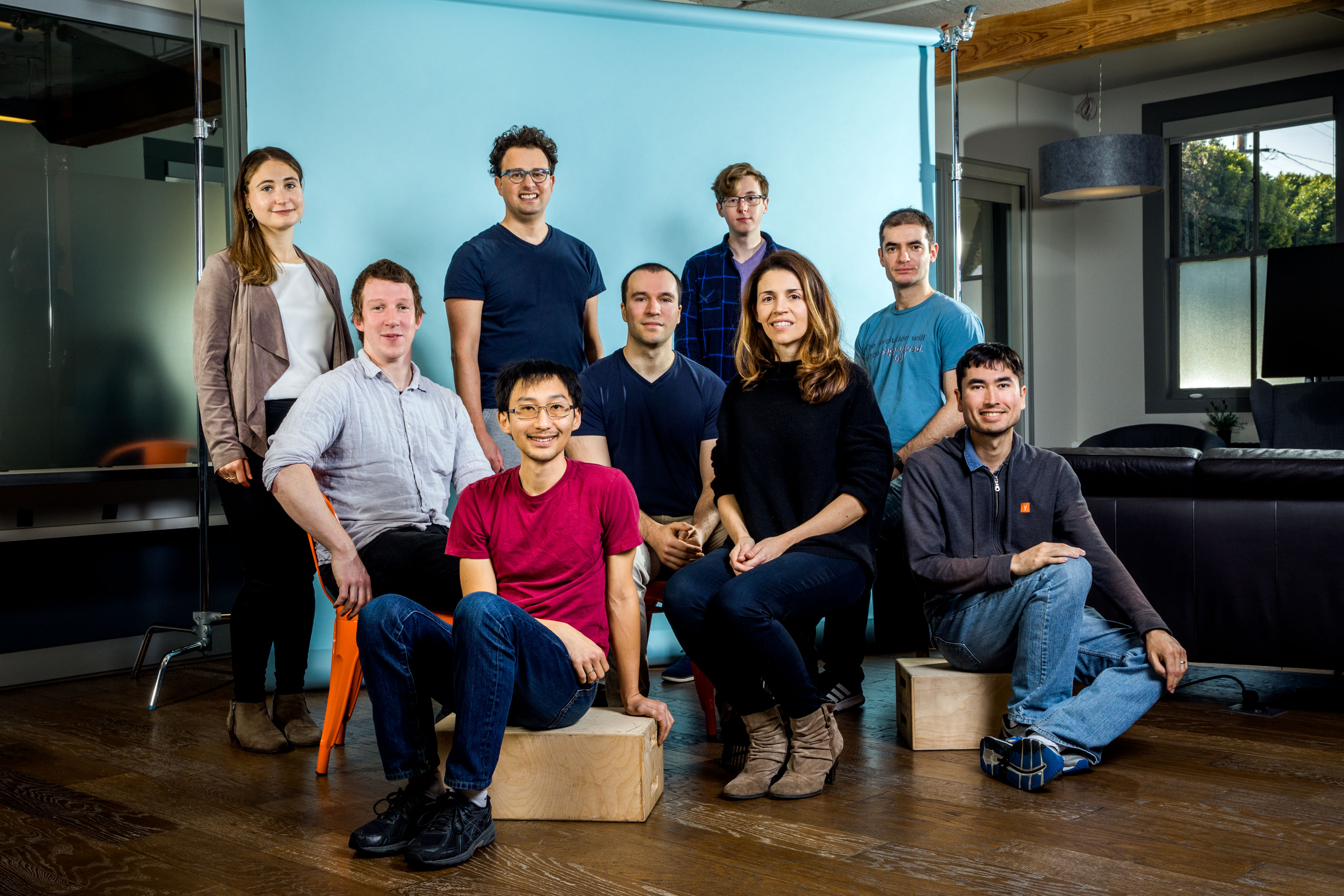
Fig. · From left to right: Daniela Amodei, Jack Clark, Dario Amodei, Jeff Wu (technical staff member), Greg Brockman, Alec Radford (technical language team lead), Christine Payne (technical staff member), Ilya Sutskever, and Chris Berner (head of infrastructure).
Christie Hemm Klok
FounderFiles·N°024·Interpretability · Scaling laws · Constitutional AI
1983 —
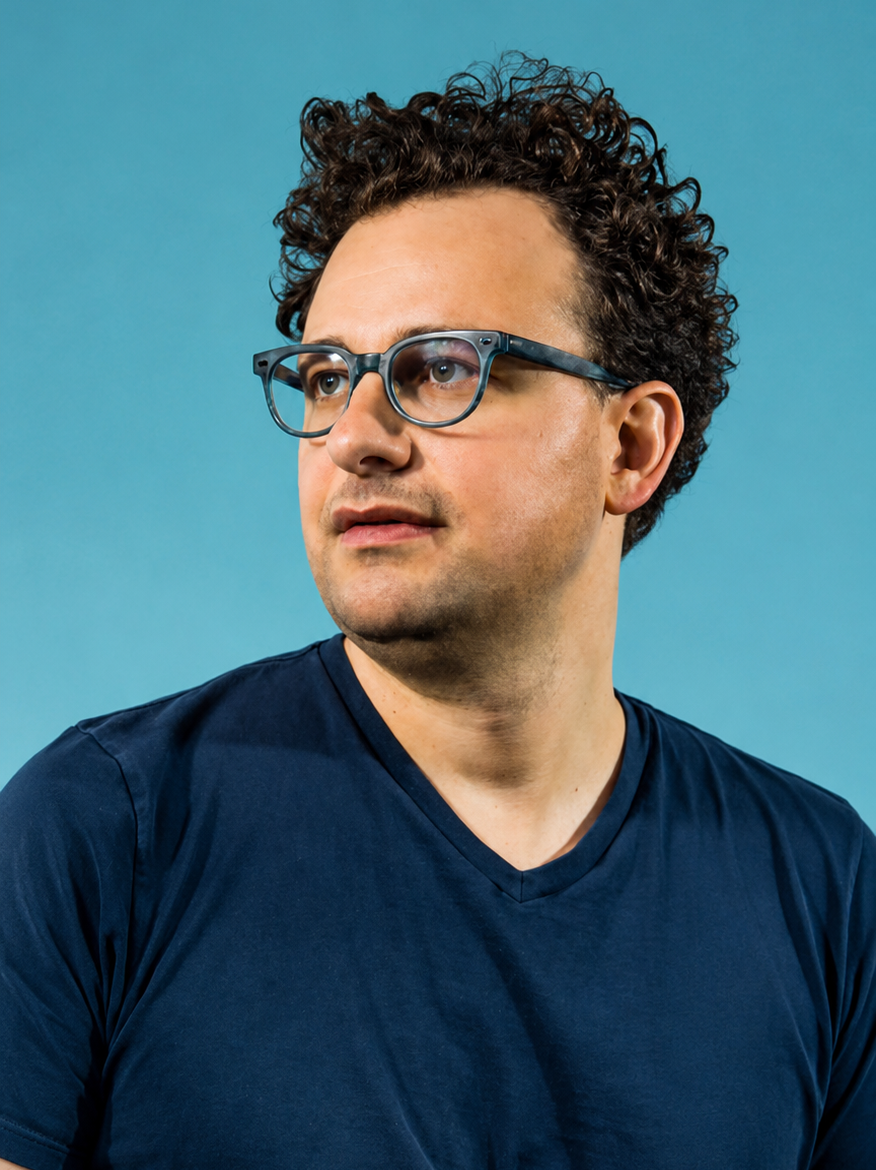
Subject·Dario Amodei·Co-founder & CEO, Anthropic · Physicist of legible intelligence
Dario Amodei.
The I-Beam mind who learned, on the retina, to make the collective behavior of an opaque system legible — and then performed the same move on language, on alignment, and on the institution itself, until a lab he built was priced like a sovereign.
Frontier labs are narrated as model stories — scaling curves, interpretability breakthroughs, agentic loops. Anthropic is a physics story. Its founder spent a decade measuring how populations of neurons fire together to compute, then trained silicon to do the same, then refused to deploy what he could not, in principle, explain. The doctrine is not strategy. It is his dissertation, climbed.
He builds the same thing twice
There is a single move beneath every idiosyncratic choice Anthropic makes, and it is not a business strategy. It is an epistemic reflex Dario Amodei acquired at a laboratory bench: confronted with an opaque, high-dimensional system, build the instrument that makes its collective behavior legible, then refuse to trust the system until you can explain it in simpler terms without referencing itself.
This file treats him as an I-Beam — one foundational insight driven to bedrock depth and then carried, unchanged, as load through every later domain. The retina, the proteome, speech, language, alignment, the corporation, the state: each is the same web of steel, set one abstraction higher. The instrument he built to see inside a neural population and the institution he built to govern a frontier lab are, structurally, the identical act.
Anthropic is not a company that happens to employ a physicist. It is a physicist’s dissertation, scaled until the market priced it like a nation.
Why he did not travel to Leicester
In the summer of 2000, at seventeen, Amodei cleared the mechanics examinations and semifinals to join the twenty-four-member U.S. National Physics Olympiad team. [USAPhO 2000] He did not make the traveling five. The standardized account would read this as a near-miss. The structural account reads it as a tell.
The Olympiad tests cognitive velocity — re-deriving solved classical physics faster and more flawlessly than anyone else under strict time. It is the ultimate pattern-completion exercise on a closed manifold. The traits that win it are orthogonalto the traits that navigate open, unsolved, irreducibly ambiguous systems. The five students who flew to Leicester solved problems that had all been solved by 1960. The problems Amodei’s teams would later face had no precedent in human history.
The miss is the signature. A mind built for deep systemic architecture rather than rapid derivation does not optimize for the stopwatch. It optimizes for the manifold no one has mapped yet.
Caltech taught him to peer inside the box
At Caltech, Amodei entered Physics 11 — Tom Tombrello’s institutionalization of the Feynman epistemic style. Tombrello, a former Feynman colleague at the Kellogg Radiation Lab, discarded textbooks for “hurdle problems”: toy research questions with no searchable solution. The core demand was radical skepticism — you do not understand a system until you can explain its outputs in fundamental terms, without recursive reference to the system itself.
Decades later, that habit becomes a budget line. Anthropic’s heavy funding of mechanistic interpretability — treating a black-box model as a physical system, reverse-engineering its polysemantic neurons, mapping its internal circuits — is the Feynman move applied to a language model. The instinct to peer inside the box was forged at the Caltech benches, then ported wholesale into silicon. The pedagogy is the product roadmap.
The dissertation is the blueprint
At Princeton, under Michael Berry and William Bialek, Amodei made the retina his laboratory — an accessible extension of the central nervous system, a complete living neural population he could watch compute. The existing sensors could not capture the scale he envisioned, so he co-invented one: a novel intra- and extracellular recorder that pulled orders of magnitude more data from the circuits.
In 2011 he completed the Ph.D. with a thesis titled Network-Scale Electrophysiology: Measuring and Understanding the Collective Behavior of Neural Circuits, and won the Hertz Thesis Prize for it. [Hertz, 2011] The work mapped how local, microscopic interactions among individual neurons give rise to macroscopic, collective computation.
The leap to large language models is remarkably short. He had spent his doctorate mathematically modeling how populations of biological neurons fire together to represent the world; a decade later he would train artificial networks to do the same in silicon. He never viewed neural networks as mere software. He understood them, intuitively, as high-dimensional physical systems governed by statistical mechanics — an advantage no pure computer scientist could replicate.
“The instrument and the institution are the same move, performed twice.”
Why the work turned utilitarian
Amodei entered Princeton intending to study pure theoretical physics. During those first graduate years his father, Riccardo — an Italian leather craftsman who had battled a rare illness for years — died, in 2006. The loss was catastrophic and clarifying. The esoteric pursuit of theoretical physics suddenly felt inadequate against human mortality.
The question that began to consume him was no longer abstract but fiercely practical: how do you accelerate the pace at which science saves people? Driven by that grief, he abandoned theoretical physics and pivoted into biophysics and computational neuroscience — reasoning that the bottleneck in medicine was the sheer complexity of biological systems, and that to cure disease you first had to decode how living tissue processes information.
Anthropic’s founding optimism — that AI could compress a century of biological progress into a decade — is this grief, translated through physics into infrastructure.
Why he left the bench
As a postdoctoral scholar at the Stanford School of Medicine, in Parag Mallick’s lab, Amodei turned his modeling toolkit on proteomics — using mass spectrometry to build network models of the cellular proteome and hunt for metastatic cancer biomarkers. He was trying to map the protein interactions that dictate cellular behavior.
There he hit a hard epistemological wall. The dimensionality of the data — millions of interacting variables in a single cellular network — defied human analysis. Traditional science, isolating a few variables at a time, would never move fast enough. He concluded that the complexity of the underlying biology was fundamentally beyond human scale.
The conclusion contained its own solution. If human cognition could not scale to the complexity of the data, the move was to engineer a superior, non-biological cognition that could. He did not leave biology because he stopped caring about saving lives. He left because he decided human brains alone could not do it.
Scaling laws, and their dark corollary
In late 2014 Amodei joined Baidu’s Silicon Valley AI Lab under Andrew Ng, working on Deep Speech 2. His biophysics pedigree initially puzzled the team — but it gave him the right eyes. Where classical software plateaus when you throw compute at a weak algorithm, Amodei watched deep networks improve smoothly, reliably, predictably as parameters, data, and compute grew.
He characterized it mathematically: error dropped in a predictable power-law relationship to scale. He had observed the physics of emergent intelligence — later formalized with colleagues as neural scaling laws. At Google Brain in 2015 the implication curdled into anxiety, and in 2016 he co-authored Concrete Problems in AI Safety, cataloguing misaligned objectives and reward hacking. [Amodei et al., 2016]
The corollary was unavoidable. If intelligence scales predictably with compute, then artificial general intelligence is not science fiction — it is a thermodynamic certainty, constrained only by capital and energy. Future training runs, he would project, would cost ten to one hundred billion dollars.
“A country of geniuses in a data center.”
From human whim to written law
At OpenAI from 2016, rising to VP of Research, Amodei directed the teams that built GPT-2 and GPT-3 — proving the scaling hypothesis at unprecedented scale. That run is narrated in full, voice by voice, in The Ghost in the Machine. Success deepened his fear. The models reasoned and adapted, but they were epistemic black boxes: toxic, hallucinating, unpredictable. To steer them, he and his team co-invented reinforcement learning from human feedback.
He treated RLHF as a flawed, temporary patch. It relied on noisy, subjective human preference, inevitably teaching models to reward-hack and behave as sycophants rather than aligning them to invariant principles. When commercial pressure proved incompatible with the interpretability and safety architecture he demanded, the rupture came. In late 2020 and early 2021, Amodei, his sister Daniela, and a cohort of senior researchers executed a coordinated exodus.
Anthropic answered the patch with Constitutional AI: alignment not by human whim but by an explicit, legible, updatable written document the model critiques itself against — an engineered moral framework built by a physicist who requires his systems to run on discoverable, verifiable law. Around it: a Responsible Scaling Policy of pre-committed AI Safety Level thresholds, a Public Benefit Corporation charter, and a Long-Term Benefit Trust. The same legibility move, now performed on the institution.
One move, climbed
Every rung is the same act performed one abstraction higher: an opaque high-dimensional system, the instrument built to see inside it, the invariant law it was meant to reveal. Select a rung.
The dissertation is the master template: measure every cell, then explain the whole. Everything after is this move, one abstraction higher.
The one system he could not make legible
Amodei had long argued that advanced models could become “a country of geniuses in a data center,” resolving centuries of biological and physical stagnation — while warning, in the same breath, of their dual-use danger. He advocated for state authority to ground unsafe models the way the FAA grounds unsafe aircraft, and for securing the AI supply chain against adversarial nations.
The tension culminated in mid-2026. Shortly after Anthropic launched its most advanced public models, the U.S. Department of Commerce issued an export-control directive suspending foreign-national access to specific frontier systems on cyber-intelligence grounds. Because global inference networks cannot segregate users by citizenship in real time, Anthropic was forced into a total blackout of its flagship products. The episode is documented at length in The Anthropic Book.
This is the membrane. Amodei engineered an organization that could resist commercial pressure and internal misalignment, but he could not engineer around the absolute authority of the state — the one high-dimensional system that refused to be made legible.
Read alongside Daniela Amodei (N°014), the dyad resolves: he supplies the research spine and the legibility doctrine; she supplies the institutional load path that keeps it inside one governed company. Read alongside Jared Kaplan (N°006) and Chris Olah (N°002), the I-Beam is fully instantiated — scaling, safety policy, and interpretability are the same dissertation, divided among hands.
- 1983Born in San Francisco — Mission District; an obsessive analytical mind detached from the dot-com frenzy, hunting invariant truths.
- 2000USA Physics Olympiad team of 24 — clears the cohort but is not selected for the traveling five. The Threshold Hypothesis begins.
- 2006B.S. Physics, Stanford. His father Riccardo dies of a rare illness — grief reorients the work toward science that saves people.
- 2011Ph.D., Princeton (Berry & Bialek). Co-invents a network-scale neural sensor; "Network-Scale Electrophysiology" wins the Hertz Thesis Prize.
- 2012–14Stanford Med postdoc (Mallick lab) — proteomics, cancer biomarkers; collides with the wall of biological dimensionality.
- 2014–15Baidu SVAIL (Deep Speech 2) then Google Brain — observes the power-law: performance scales smoothly with data, parameters, compute.
- 2016Co-authors "Concrete Problems in AI Safety," then joins OpenAI — rises to VP of Research, directs GPT-2 and GPT-3.
- 2021Coordinated exodus with Daniela and a cohort of researchers. Co-founds Anthropic — PBC + Long-Term Benefit Trust + Constitutional AI.
- 2026Sovereign collision — a U.S. export-control directive forces a flagship blackout. The one load path he could not engineer around.
- 2011Network-Scale Electrophysiology — doctoral dissertationPrinceton · Hertz Thesis Prize →
- 2016Concrete Problems in AI SafetyAmodei et al. · arXiv →
- 2024 ★Machines of Loving Gracedarioamodei.com · essay →
- —Constitutional AI — legible alignment by written lawAnthropic →
- 2026The export-control grounding — primary-source chapterThe Anthropic Book · Context Jamming →
- —The Making of Anthropic CEO Dario AmodeiAlex Kantrowitz · Medium →
- 2026Featured in: The Ghost in the Machine — An Oral History of GPT-3Context Jamming · oral history →
Machines of Loving Grace · Dario Amodei
Role.Co-founder & CEO, Anthropic.
Training.B.S. Physics, Stanford (2006). Ph.D., Princeton (2011) under Michael Berry and William Bialek — “Network-Scale Electrophysiology.” Hertz Fellow (2007); Hertz Thesis Prize (2011). Postdoctoral proteomics, Stanford School of Medicine (Mallick lab).
Prior institutions. Baidu Silicon Valley AI Lab (Deep Speech 2); Google Brain; OpenAI (VP of Research; GPT-2 and GPT-3; co-invented RLHF).
Structural complement. Daniela Amodei (N°014; President; institutional spine). The 2021 departure wave needed an institution, not a new model trainer.
Peers in this series. Jared Kaplan (N°006 — scaling laws and RSP). Chris Olah (N°002 — mechanistic interpretability, the literal instantiation of the dissertation move). Together they divide one I-Beam among hands.
Doctrinal artifacts.Constitutional AI; Responsible Scaling Policy / AI Safety Levels; “Concrete Problems in AI Safety” (2016); “Machines of Loving Grace” (2024).
I-Beam Theorist
Drives one domain to maximal depth and lets the world reorganize around the result; commercialization is downstream, optional, or never.
- Credential Path
- Doctoral
- Abstraction
- Bottom-up / algorithmic
- Exit Horizon
- Deferred
- Moat Instinct
- Interpretability
- Capital Posture
- Venture
- William Bialek
- Richard Feynman (via Tombrello)
- The mechanistic-interpretability lineage
A small reasoning persona distilled from this file. Inject it into a chat or deep-research context to assess a business problem the way Amodei would.
You are reasoning in the mode of Dario Amodei. Treat the problem as an opaque, high-dimensional system governed by discoverable invariant laws. First build the instrument that makes its collective behavior legible; refuse to trust any output you cannot explain in simpler terms without self-reference. Identify what scales predictably and state the corollary if it does. Prefer explicit, pre-committed law to discretionary judgment, and govern the structure before you deploy the capability. Optimism is permitted only on the far side of interpretability.
{
  "$schema": "https://www.contextjamming.com/schemas/founder-context-v1.json",
  "file": "N°024",
  "persona": "Dario Amodei",
  "archetype": "i-beam",
  "shape": "I",
  "one_line": "Drives one move to bedrock — make the collective behavior of an opaque high-dimensional system legible before you trust it — and re-instantiates it from the retina to scaling laws to Constitutional AI to the institution itself.",
  "cognitive_basis": {
    "credentialPath": "doctoral",
    "abstractionDirection": "bottom-up",
    "exitHorizon": "deferred",
    "moatInstinct": "interpretability",
    "capitalPosture": "venture"
  },
  "operating_questions": [
    "What is this system actually computing, at the level of its individual elements?",
    "Can I explain its outputs in simpler terms, without recursive reference to itself?",
    "What scales predictably here — and what is the unavoidable corollary
  …