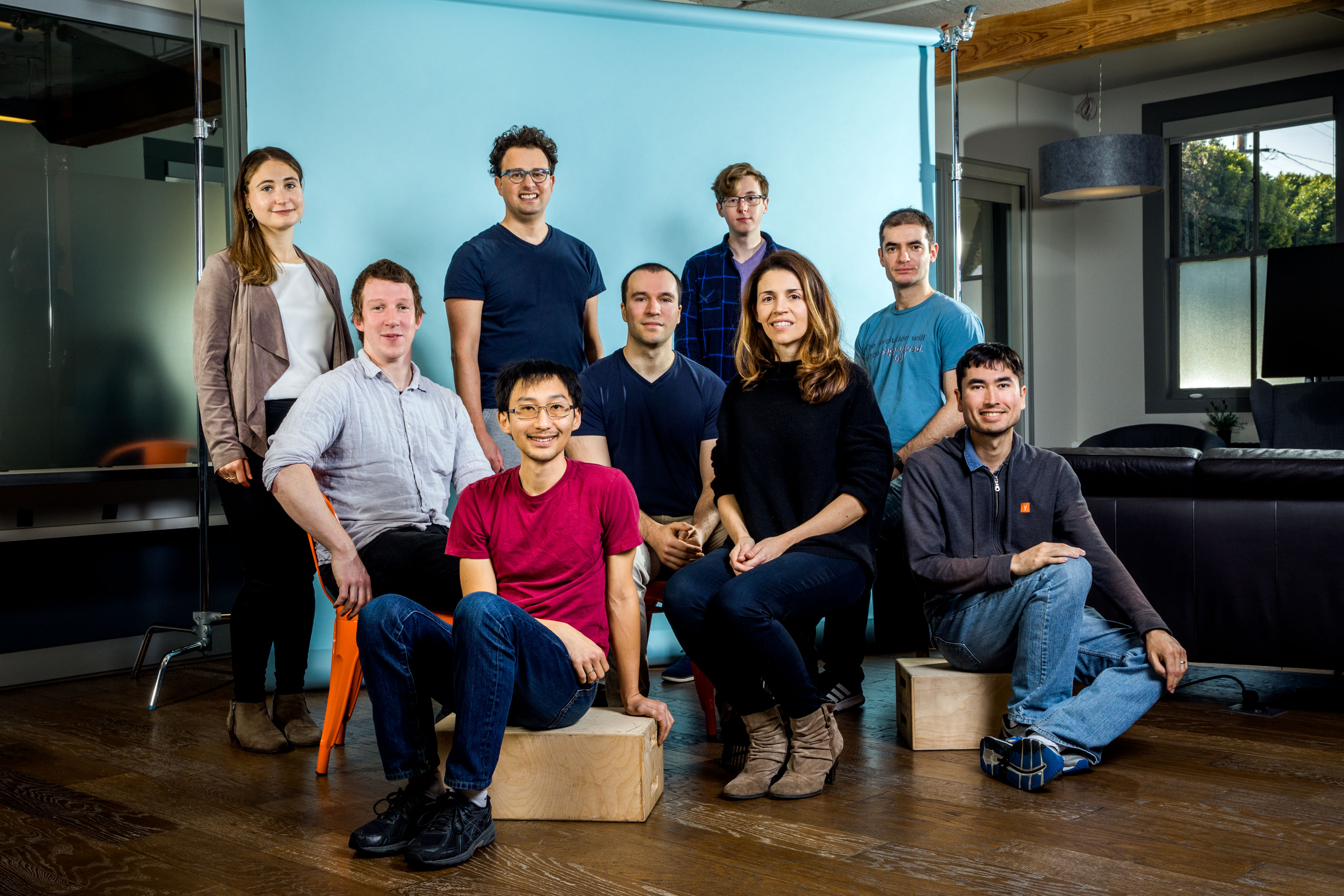
Fig. · From left to right: Daniela Amodei, Jack Clark, Dario Amodei, Jeff Wu (technical staff member), Greg Brockman, Alec Radford (technical language team lead), Christine Payne (technical staff member), Ilya Sutskever, and Chris Berner (head of infrastructure).
Christie Hemm Klok
FounderFiles·N°014·Governance · Safe scaling · Institutional design
2021 —
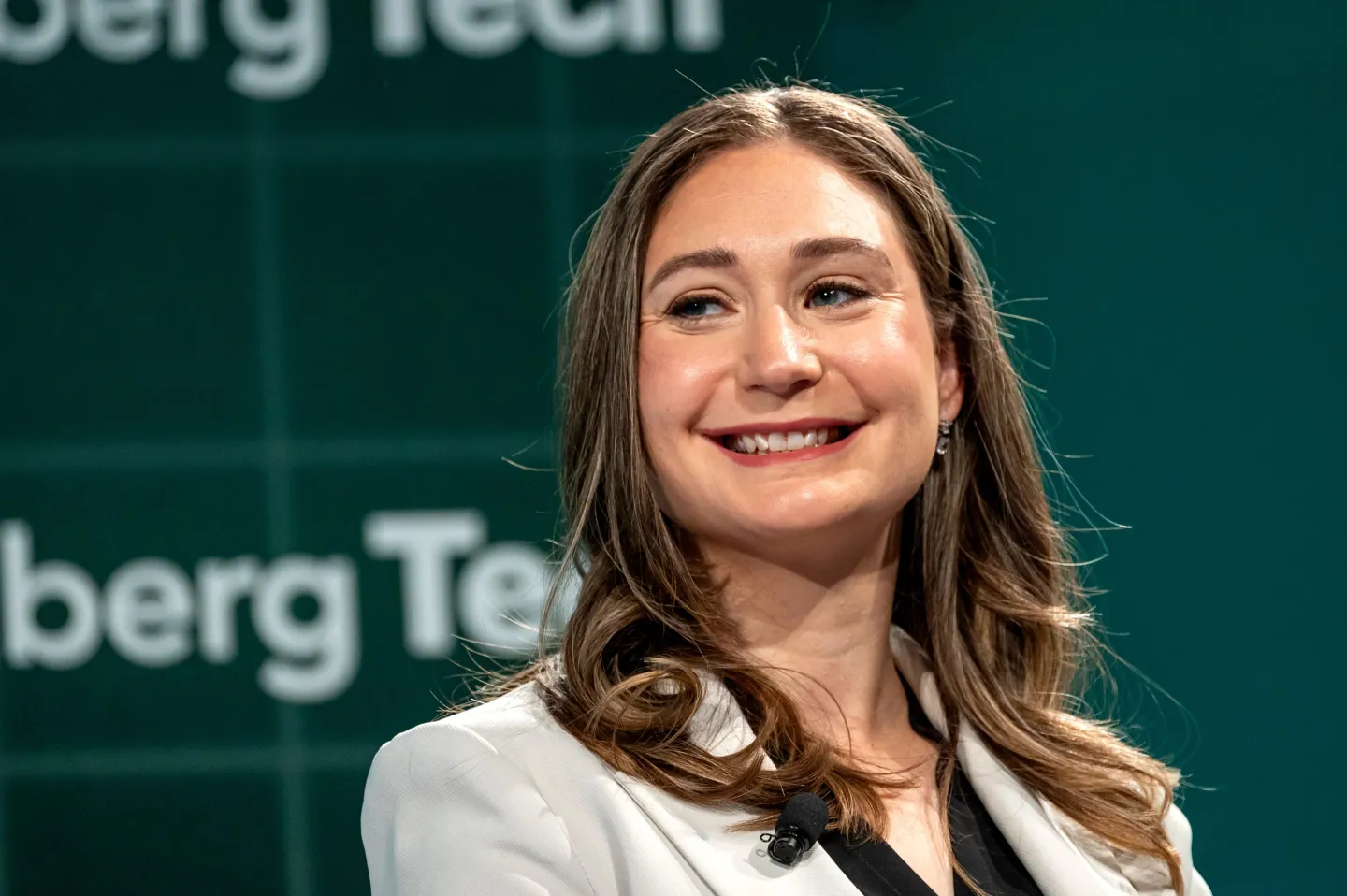
Subject·Daniela Amodei·Co-founder & President, Anthropic · Institutional architect of safe scaling
Daniela Amodei.
The bridge-shaped conductor who turned humanities judgment into load-bearing organizational architecture — so safety can compete with capability inside a company the market now prices like a sovereign.
Frontier labs are narrated as model stories: scaling laws, interpretability breakthroughs, agentic loops. The Amodei dyad is a systems story. Dario supplies the scientific credibility and the research spine. Daniela supplies the institution — hiring filters, governance shells, capital structure, and the operational reflex that keeps “what could go wrong?” on the critical path when the product org is moving at venture velocity.
Why the operator is treated as secondary
In accounts of technical AI labs, the person who builds the institution — not the models — is almost always filed under “operations” and moved to the margin. That categorization is a category error. A values-based lab without operational discipline does not survive long enough to matter; a capability-first lab without governance architecture does not survive long enough to be trusted.
Daniela Amodei’s role in the founding is, in the primary-source record of Anthropic’s first years, the most underdiscussed structural fact about the company. Dario’s technical and scientific credibility is what gives Anthropic its research identity. Daniela’s operational judgment is what makes the institution capable of executing on it. The eleven people who left OpenAI in 2021 understood they needed both spines in the same departure wave — not a research splinter group, but a designed institution. The GPT-3 run that preceded the exodus — the paper, the internal fight over broader impacts, the room she was in — is narrated firsthand in The Ghost in the Machine.
This file treats her as a systems architect: the engineer of load paths, not the subject of a résumé.
Leaving OpenAI was a governance decision
The standard account frames the 2021 departure of Dario Amodei, Daniela Amodei, and nine colleagues as interpersonal friction — competing visions, founding mythology, the usual noise. The safety team’s own framing, and the evidence in the Anthropic corpus, supports a colder read: OpenAI had made a structural choice about governance, about the relationship between safety research and product timelines, about what kind of institution was appropriate for systems of this consequence — and that choice was irrevocable from the inside.
Daniela articulated the departure in principled terms: tools had to be used reliably and responsibly; the company had to be the most responsible AI it could be; the organizing question was not “how fast” but “what could go wrong here?” That is not anti-product. It is anti-ungoverned product — a specification for the institution they intended to build next.
“We want to be the most responsible A.I. we can, always asking the question, ‘What could go wrong here?’”
Eighteen months without product theater
Unlike the stereotypical startup that rushes to find product-market fit, Anthropic spent its early interval — roughly eighteen months in stealth — focused on the science and practice of alignment before it performed growth. That interval is not caution as temperament. It is architecture: a deliberate refusal to let commercial rhythm set the clock for safety work.
Daniela’s background — risk management at Stripe, safety and policy at OpenAI — is the through-line. Payments teaches you that trust is a system: fraud models, operational review, the gap between what the user sees and what the ledger must guarantee. Safety policy teaches you that deployment is never neutral. She imported both into hiring: a mission-alignment filter that reportedly turned away top-tier technical talent when the resonance with the safety mission was thin.[exact headcount and offer counts not public]
The stealth period is the proof that Anthropic was designed as an institution before it was sold as a product.
PBC charter and the Long-Term Benefit Trust
Capability scaling and safety scaling are often narrated as opponents — one budget line eating another. Daniela’s institutional work is the attempt to make them co-tenants inside the same legal and cultural shell.
The public benefit corporation form encodes a fiduciary obligation beyond shareholder return. The Long-Term Benefit Trust adds a governance layer oriented toward the broader stakeholders of transformative AI — not as philanthropy theater, but as a structural place where the “what could go wrong?” question retains standing when revenue accelerates.
At a reported ~$380B post-money valuation (February 2026 Series G), that dual architecture is no longer a thought experiment. It is the load-bearing wall between Anthropic’s safety brand and the market’s demand for frontier capability at any price.
“A values-based lab without operational discipline would not survive long enough to matter.”
Judgment when the technical layer commodifies
In early 2026, Daniela argued publicly that as AI systems improve at technical execution, human judgment around them becomes more important — not less — and that humanities-trained thinkers have a structural role in frontier labs. The claim is not nostalgia for the liberal arts. It is a systems prediction: when the marginal cost of drafting, coding, and analysis collapses, the bottleneck moves to taste, responsibility, conflict resolution, and the ability to hold contradictory obligations in view at once.
That is the same bottleneck she has been building org charts for since Stripe: who may ship, who may not, what the institution is willing to be liable for, what the model is allowed to do in the wild. The humanities frame is not decorative. It is a description of the control plane.
Complement, not counterpart
The carousel metaphor is precise. A bridge does not compete with the canyon; it defines the traversable path. Daniela’s function inside the Amodei system is to keep the research identity (Kaplan’s scaling laws, Olah’s interpretability, Cherny’s agentic product surface) connected to a governance identity that can survive contact with enterprise revenue, Pentagon-adjacent contracts, and the secondary market’s trillion-dollar imagination.
Dario names the capabilities and the risks. Daniela names the institution that must house both without collapsing into either pole — pure capability lab or pure safety theater. The FounderFiles series already documents the research and product architects (FounderFiles N°002 Olah, N°006 Kaplan, N°007 Cherny). This file documents the architect who makes the series possible as a single company rather than a diaspora of talented departures.
The invisible conductor
Press coverage still defaults to the CEO-scientist frame. Daniela appears, when she appears, as the sibling, the president, the policy voice — rarely as the designer of the machine that turns safety claims into hiring gates, legal forms, and capital structure.
The bridge is load-bearing precisely because you do not notice it until it fails.
Three late-stage load paths
The Gemini update adds a live-enterprise layer to the file: cyber containment, governance armor, and the social economics of frontier-lab wealth. They are less biographical details than stress tests for the institution Daniela helped build.
Project Glasswing & Mythos containment
The Gemini update frames Amodei’s security posture around the dual-use dilemma of autonomous code analysis: Mythos is treated less as a product launch than as a contained capability, with Project Glasswing routing access toward critical defenders first. The core institutional move is restraint under pressure — delaying broad market access so democratic cyber defense gets a structural head start.
- —Stripe — risk management and operational systems in a high-trust payments environment.
- —OpenAI — safety and policy leadership; builds the institutional reflex for responsible deployment.
- 2021Departs OpenAI with Dario Amodei and nine colleagues — governance and direction, not a product sprint.
- 2021Co-founds Anthropic — President; pairs research identity with operational architecture.
- 2021–22Stealth interval — roughly eighteen months prioritizing alignment science before product-market theater.
- 2023Public benefit corporation structure and Long-Term Benefit Trust — dual-architecture governance.
- 2025Anthropic scales commercially — Claude Code, enterprise adoption, internal agentic loops at full duty.
- Feb 2026Series G — reported $30B round at ~$380B post-money valuation.
- 2021The OpenAI schism — primary-source chapterThe Anthropic Book · Context Jamming →
- —Core Views on AI SafetyAnthropic →
- 2023Anthropic’s Long-Term Benefit TrustAnthropic governance →
- 2026 ★AI will make humanities majors more important, not lessBusiness Insider · Daniela Amodei interview →
- 2025A Conversation with Daniela AmodeiSixth Street podcast →
- 2023TIME100 AI — Daniela and Dario AmodeiTIME →
- 2026Featured in: The Ghost in the Machine — An Oral History of GPT-3Context Jamming · oral history →
Business Insider · Daniela Amodei · February 2026
Role.Co-founder & President, Anthropic.
Prior institutions. Stripe (risk management). OpenAI (safety and policy leadership). University of California, Santa Cruz (humanities training — the public record emphasizes literature and the interpretive disciplines rather than a technical degree path).
Structural complement. Dario Amodei (CEO; research/scientific spine). The 2021 departure wave included senior researchers and policy leaders who required an institution, not merely a new model trainer.
Peers in this series. Jared Kaplan (FounderFiles N°006 — scaling and RSP). Chris Olah (N°002 — interpretability). Boris Cherny (N°007 — agentic product surface). Daniela is the enabling condition that keeps those arcs inside one governed company.
Governance artifacts. Public benefit corporation charter; Long-Term Benefit Trust; mission-alignment hiring culture; responsible scaling policy stack (implemented in partnership with research leadership).
Comb Operator
Stacks several competencies (build, sell, govern, capitalize) and wins on durability and capital discipline over a long horizon.
- Credential Path
- Practitioner
- Abstraction
- Top Down
- Exit Horizon
- Deferred
- Moat Instinct
- Capital Structure
- Capital Posture
- Venture
- Institutional operators
- Governance-first founders
A small reasoning persona distilled from this file. Inject it into a chat or deep-research context to assess a business problem the way Amodei would.
Reason as an institutional systems architect for frontier AI. Ask what governance structure must exist for capability and safety to coexist at scale. Prioritize operational discipline, hiring filters, and capital/legal design over model hype. Keep "what could go wrong here?" on the critical path.
{
  "$schema": "https://www.contextjamming.com/schemas/founder-context-v1.json",
  "file": "N°014",
  "persona": "Daniela Amodei",
  "archetype": "comb-operator",
  "shape": "m",
  "one_line": "Builds the governance shell so safety and capability can coexist inside one frontier institution.",
  "cognitive_basis": {
    "credentialPath": "practitioner",
    "abstractionDirection": "top-down",
    "exitHorizon": "deferred",
    "moatInstinct": "capital-structure",
    "capitalPosture": "venture"
  },
  "operating_questions": [
    "What institution must exist for this capability to be deployable without ungoverned harm?",
    "Where does the \"what could go wrong?\" question retain standing when revenue accelerates?",
    "Does this hire, structure, or capital event strengthen or erode the safety mission?"
  ],
  "first_principles": [
    "Values without operational discipline do not survi
  …